
Much that passes as idealism is . . . disguised love of power. — Bertrand Russell
Last First Day, I joined a group of Friends for Bible study an hour before worship at annual sessions of Ohio Yearly Meeting (Conservative). The text before us was Mark 3:1-6 in which Jesus heals a man with a withered hand and evokes the ire of the Pharisees:
1And he entered again into the synagogue; and there was a man there which had a withered hand. 2And they watched him, whether he would heal him on the sabbath day; that they might accuse him. 3And he saith unto the man which had the withered hand, Stand forth. 4And he saith unto them, Is it lawful to do good on the sabbath days, or to do evil? To save life, or to kill? But they held their peace. 5And when he had looked round about on them with anger, being grieved for the hardness of their hearts, he saith unto the man, Stretch forth thine hand. And he stretched it out: and his hand was restored whole as the other. 6And the Pharisees went forth, and straightway took counsel with the Herodians against him, how they might destroy him (KJV).
The first two verses of this passage introduce the short narrative’s two strands of interest: (1) a man is to be healed, and (2) there’s opposition between Jesus and the Pharisees. In verse 3, Jesus prioritizes the first of these two—that is, the healing—by first giving his attention to the man with the withered hand and telling him to “Stand forth.” Though given initial priority, the healing is primarily a catalyst to precipitate the main plot line of this story: the conflict between Jesus and the Pharisees.
After having spoken to the man, Jesus turns to the Pharisees and rhetorically asks: “Is it lawful to do good on the sabbath days, or to do evil: To save life, or to kill?” (v. 4) With this question, Jesus identifies opposing principles: do good and save life, or do evil and kill. Having defined the two conflicting positions, Jesus then demonstrates through the healing which of the two he upholds; that is to say, he is on the side of doing good and saving life. Seeing the demonstration, the Pharisees are left to conclude on which of the two sides their opposition to Jesus puts them, and they must realize that they occupy the side of doing evil and killing. The verse that follows confirms this fact: “And the Pharisees went forth and straightway took counsel with the Herodians against him, how they might destroy him” (v. 6).
The person of today may read this story and quickly judge the Pharisees to be inexcusably wrong in their insistence on the Law with its hard-and-fast Sabbath rules: that this error was something from long ago that we have progressed well beyond. I propose, however, that the present-day elevation of ideals to the position of primary guiding force of individual or corporate life is but a reenactment of the Pharisees mistake: both Law and ideals are secondary ethical standards that usurp the central place of Christ, both within a person and within the religious group. Where Christ should be central, ideals are instead rallied around. As was shown in this brief story at the beginning of Mark 3, such usurpation will inevitably entail hostility toward the true standard of righteousness: Christ, the Lord our righteousness (Jer. 33:16).
Although the Law of Moses is no longer weaponized to ensure conformity in and manageability of religious communities, different ideals—peace, love, and community—occupy the pedestal in both Liberal and Christian groups. Psychological techniques have replaced physical violence as the means to compel conformity and self-censorship.
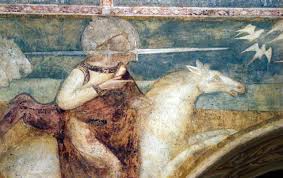
In some Christian groups, Jesus is presented as vapidly sweet, and never as he appears in Revelation where he is “called Faithful and True,” from whose mouth issues “a sharp sword with which to smite the nations” (19:12,15 NEB). All the while in passages such as the one at the beginning of Mark 3, we see Jesus exercising that sword as he puts in place the culprits who hide their love of power behind the guise of ideals. Jesus looks at them with anger and sorrow at their obstinate stupidity (v.5).
“Stretch forth thine hand” (v. 5).
It is the man with the withered hand whom Jesus heals. The hand is the means by which Man can make or do; it is the means by which a person can express outwardly what is within: that is, it is the means by which one creates. Symbolically, Christ’s restoration of the hand tells of the person’s new-found gift to bring forth what is within that it may become visible to the world.
 Abiding Quaker