
For more than a year now, I’ve been attending the Canadian Friends Historical Association’s (CFHA) biweekly Zoom meetings to read and discuss the Journal of George Fox. Called “Friendly Fridays,” the hour-and-a-half to two-hour sessions are one means by which CFHA carries forward its mission “to preserve and communicate the history and faith of the Religious Society of Friends in Canada.” (More may be learned of their activities by visiting their website: cfha.info.)
Generally, around a half-dozen or so Friends from Canada, a few from the United States, and one or two from Europe attend. Recently, a YouTube channel was created, which features recordings of our discussions. Near the end of this introduction, I’ll provide information and a link for accessing one of our recent discussions, which was held on 12/9/22. The topic slated for discussion that afternoon was Fox’s answers to charges of blasphemy, given at Sessions at Lancaster in 1652. Fox answered the eight charges leveled at him by justice Colonel William West by using Scripture passages to defend his position. Although there were eight charges, our group reviewed only three of them at that meeting: #s 1, 3, and 7, which I’ll copy below.
In the edition of the Journal that we use, the Nickalls 1985 edition, the exchange between the justice and Fox can be found on pages 134 and 135. Editor Nickalls follows each charge with Fox’s answer and a list of verses from Scripture that Fox used to support his words. Preparing for the Friendly Friday session, I checked these Scripture references and found many of them to be faulty (Fox had made no reference to the specified verses Nickalls had listed, but Fox had referred to other verses), and so I located the correct verses and listed them in a document I had prepared and then sent out to a number of other group participants. Below are three (#s 1, 3, and 7) of the eight charges put to George Fox at Lancaster Sessions in 1652, and Fox’s answers with references to Scriptures underlined.1
__________________________________________________________
#1. The charge against Fox: That he did affirm that he had the divinity essentially in him.
Fox’s answer: For the word essentially, it is an expression of their own, but that the saints are the temples of God and God doth dwell in them (1 Cor. 3:16) that I witness and the Scripture doth witness, and if God doth dwell in them the divinity dwelleth in them and the Scriptures saith the saints shall be made partakers of the divine nature (2 Pet. 1:4) this I witness.
The verses that Fox refers to in his answer are transcribed below:
1 Cor. 3:16 Know ye not that ye are the temple of God, and that the Spirit of God dwelleth in you?
2 Pet. 1:4 Whereby are given unto us exceeding great and precious promises: that by these ye might be partakers of the divine nature, having escaped the corruption that is in the world through lust.
#3. Fox was charged: He did dissuade men from reading the Scriptures telling them it was carnal.
Fox’s answer: For dissuading men from reading the Scriptures, it is false, for they were given to be read as they are and not to be made a trade upon. But the letter is carnal and killeth, but that which gave it forth is spiritual and eternal and giveth life (2 Cor. 3:6). This I witness.
The verses that Fox refers to in his answer are transcribed below:
2 Cor. 3:6: Who also hath made us able ministers of the new testament; not of the letter, but of the spirit; for the letter killeth, but the spirit giveth life.
#7. Fox was charged with having said: That he was judge of the world.
Fox’s answer: The saints shall judge the world (1 Cor. 6:2), the Scripture doth witness, whereof I am one, and I witness the Scripture fulfilled.
The verse that Fox refers to in his answer is transcribed below:
1 Cor. 6:2,3 Do ye not know that the saints shall judge the world? And if the world shall be judged by you, are ye unworthy to judge the smallest matters? Know ye not that we shall judge angels? How much more things that pertain to this life?
______________________________________________________
Although our discussion was ostensibly to focus upon the trial at Lancaster, it often moved into more general topics regarding the faith of early Friends. For example, early on in the recording (from 8:00–17:00), there’s a discussion on the way Friends read the Bible. A discussion on charge #7 (beginning around 17:30), which is concerned with judgment, began by delving into different inward conditions that either disable or empower a person to judge righteously. That, in turn, led to a discussion of Friends doctrine of perfection (27:40). From 34:00 to 1:03 in the recording (or thereabouts), differing ideas are aired on early Friends claim that the inward Cross—i.e., dying to the Self—is a necessary precondition to receiving Life in Christ. A contribution on gifts occurs near the end, and the telling of an incident involving dying to the self completes the session.
To locate this recording, follow this link: is.gd/georgefox, scroll once to the right, and click on the item titled “3 Blasphemy Refuting Scriptures Fox Uses to Defend vs. charges of Blasphemy by the Lancaster Priests.” Preliminary material on the geographical area around Lancaster and linguistic tools for Bible study consumes the first eight minutes of the recording. A discussion on Friends way of reading the Bible begins at 8:00.
1 George Fox, The Journal of George Fox, ed. John L. Nickalls (Philadelphia: Religious Society of Friends, 1985), 134-5.
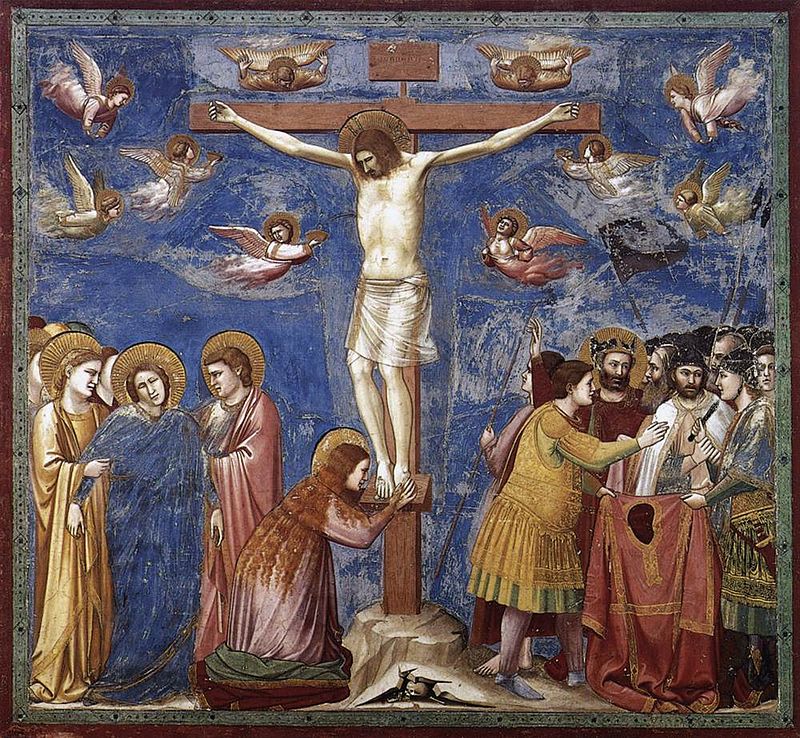
Crucifixion of Jesus by Giotto 1303-5

 Abiding Quaker