
Occasionally in Scriptures, we catch a glimpse of Jesus learning to better perform his work. Chapter 7 of Mark gives us one such example. Midway through this chapter is an encounter with a woman from Phoenicia, an area north of Jesus’s own region of Galilee. Ironically, this woman teaches Jesus that he’s come perilously close to making the same errors with which he has earlier accused the Pharisees and chastened his disciples. Jesus, however, learns from the incident and is then able to carry on his work more effectively.
Chapter 7 has four parts: (1) Jesus lambastes the religious authorities [1-13]; (2) teaches the people and his disciples [14-23]; (3) encounters the Syrophenician woman [24-30]; and, finally, (4) heals the deaf, dumb man [31-37].
Jesus lambastes the religious authorities (1-13)
Isaiah was right when he prophesied about you hypocrites in these words: “This people pays me lip-sevice, but their heart is far from me: their worship of me is in vain, for they teach as doctrines the commandments of men”1 (6).
Quoting the prophet Isaiah (29:13), Jesus charges the religious authorities with the all-too-common error of relinquishing the imperative to honor God so as to practice man-made religion. What interests me in this first passage of the chapter, however, is not Jesus’s valid criticism of the authorities. Rather my attention is drawn to what appears to be ebbing power in Jesus’s speech, from the beginning of the passage to its end.
After a strong start – quoting the great prophet and succinctly identifying the offenders’ spiritual error – Jesus launches into a specific example: i.e., the Corban oath, a man-made addition to the tradition. His lengthy, detailed account of this practice (10-13) seems to convey a pent-up resentment of the authorities’ hypocrisy, as it does not address the topic at hand: that his disciples don’t wash their hands before they eat (5). Jesus’s resentment – though understandable – is a self-indulgent, emotional release. Its spiritual consequence can be monitored through the loss of power in his speech as it progresses. He ends this exchange with the authorities with what appears to be a vague attempt to load on more fault: “And many other things that you do are just like that” (13). It is as if he is trying to regain the force he felt and manifested at the beginning of the exchange.
Jesus teaches the people and his disciples (14-23)
Although Jesus is superb in his use of metaphor to explain that defilement comes from within and not from without, his lack of patience with his hearers – both people and disciples – shows. He asks his disciples, “Are you as dull as the rest?” (18) Regardless of how astonished Jesus is at his hearers’ lack of understanding, he does not foster their learning by remarking on the magnitude of their insensibility.
In both of the beginning episodes of this chapter, Jesus has exhibited great understanding of the faith, but he’s shown himself unable to present the wisdom in a way that is beneficial to others; in fact, his presentation thwarts his intent to communicate. With the religious authorities, he veers off into a complex description of a different offense, and with the people and disciples, he speaks beyond their ken. He’s resentful toward the former, and surprised and annoyed with the latter.
Jesus encounters the Syrophoenician woman (24-30)
This pivotal mid-chapter episode begins with Jesus attempting to hide himself away from others in a house in Phoenicia (24); one surmises that he was disgruntled with his recent encounters and felt entitled to some respite. We are told that his intention was not met, for “he could not be hid”(24 KJV). Here we are subtlely reminded that the prophet’s will is not always in accord with the Father’s, and it is the Father who prevails: a lesson also taught in the tale of Jonah.
In this passage with the Syrophoenician, Jesus’s attention is turned once again to the earlier concern of defilement or the “unclean spirit.” (It’s as if he’s given another chance to – this time – get it right.) In comes a woman in great need; her young daughter has an “unclean spirit” (25), and she seeks Jesus’s help to “cast forth the devil out of her daughter”(26). Her plea for his help is rebuffed with his harsh words:
Let the children first be filled: for it is not meet to take the children’s bread, and to cast it unto the dogs (27).
Jesus calls the woman seeking help a dog; she is a Gentile, a Phoenician of Syria: not of his faith and not of his nation. Just as earlier in the chapter, the religious authorities were bound by man-made, cultural rules, Jesus here is likewise bound by cultural suppositions: namely, it is the children of Israel who alone have the right to the spiritual sustenance God has sent to his people; others, not of this nation, are not worthy of this gift. Similarly, just as the people and disciples were ignorant of the dynamics of defilement, Jesus here shows himself to be ignorant of God’s loving Providence for all people.
At this turning point in the chapter’s narrative, Jesus is schooled by a Gentile woman of a foreign nation. (Could there be a more humbling circumstance!) To his ignorance and pride, the woman responds with humility: “Yes, Lord: yet the dogs under the table eat of the children’s crumbs” (28). The teachable prophet, now humbled, acknowledges her humility and its remediating effect: “For saying that, you may go home content; the unclean spirit has gone out of your daughter”(29 NEB).
True humility is a spiritual condition that is located beyond its semblance: the man-made, voluntary counterpart (Col. 2:18 KJV). It is not humility for humility’s sake but accompanies the realization that one is sent not to claim ownership of and gratify oneself with the heavenly gifts that have been bestowed. True humility is to suspend the self with its fleshly pride and resentment, for the work to be done must and will originate from the higher and truer Spirit.
Jesus heals the deaf, dumb man (31-37)
In the first verse of this final passage, we are told that Jesus has left the foreign land and is located in his home country of Galilee (31). He is at home geographically and metaphorically: spiritually at home in his newly recovered humility. He no longer is engaging in diatribes against the hypocrites or marveling at the dullness of the people. In fact, he hardly speaks at all but silently acts to heal humanity one person at a time (33). No longer reacting to the “godforsaken, obscene, quicksand of life,”2 he instead looks to and settles his mind in heaven, though human sighs and groans still accompany his work (34).
The Aramaic word “Ephphatha” is his sole verbalization in this final passage. He now speaks in language that can be understood by those around him: in words that are not beyond the ken of the metaphorically deaf and dumb. His language, the Word, mediates the spiritual separation between heaven and ailing humanity (34 -35): “Be opened” is his Word within, his command and pronouncement.
Ending the chapter is the familiar charge that no one be told of the healing. Jesus would have all be open and unprejudiced by stories of his power that inevitably lead to mistaken interpretations and expectations, which cannot be anything but a hinderance to his work. Nevertheless, his command goes unheeded, and the people remain astonished and uncomprehending that he “makes the deaf hear and the dumb speak” (37).
If any man have ears to hear, let him hear (16).
1 The version of the Bible used here is The New English Bible, but I have also used the King James Version. In the text of the essay, I’ve indicated when there’s been a shift from one to the other.
2 This phrase is from a poem by Ann B. Weems titled “Jesus Wept,” from her book Psalms of Lament, which was published in 1995 by Westminster John Knox Press. The poem was featured in the April 18, 2023, issue of “Richard Rohr Daily Meditation,” an online publication of the Center for Action and Contemplation,.
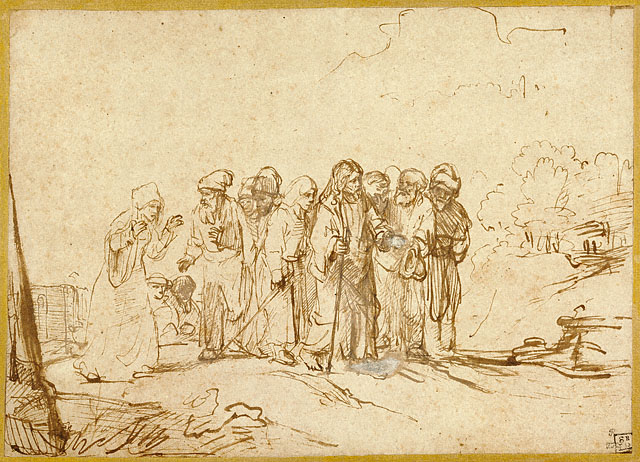
Jesus and the Canaanite Woman, 1650 Rembrandt
 Abiding Quaker