
When we read the parables of the Good Samaritan or the Prodigal Son, our first question is not, did this really happen? Rather we ask, is this true? Or even better, we ask, in what way is this true for me? Does this correspond to my own experience? [George] Fox seemed to read not just the parables but the entire Bible as a parable, constantly asking how it applied to his own condition.1 –Tom Gates
No consideration of Mark’s Gospel is complete without an attempt to explain the seeming rupture between the first and second halves of its last chapter. The first eight verses of the chapter follow the women to the tomb, and from there, we see them leave, amazed and afraid. Though instructed to “tell his [Jesus’s] disciples and Peter” that he will show himself to them in Galilee (7), the women said nothing to anyone (8). The second half of the chapter then begins afresh with a completely different narrative. Jesus is present, active, and appearing to Mary Magdalene: the same Mary who visited the tomb with two other women in the first half of the chapter, in which none of them saw or received instruction from Jesus. The explicit ending of the first half in which the women are silent about their experience is contradicted in the second half, where Mary Magdalene “went and told [the disciples] that [she] had been with [Jesus] . . . that he was alive, and had been seen of her” (10–11).
This disjointed post-crucifixion narrative can be most usefully examined, I believe, in the way that George Fox and other early Friends would have examined it: the way described by Friend Tom Gates in the epigraph. A careful look at the text brings to mind the inward experience that reconciles the discordant halves into coherent spiritual knowledge and teaching. One realizes the writer’s intent could not have been better accomplished by a conventional realistic narrative, and one finishes the reading amazed and full of gratitude.
Part One: verses 1–8
The first two verses of part one set forth its theme: the old is past and the new is begun. The first verse tells of custom and tradition, the old guides of the past: “And when the sabbath was past, Mary Magdalene, and Mary the mother of James, and Salome, had bought sweet spices, that they might come and anoint him.” Tradition directs and orders the attending women’s thoughts and actions: they’ve waited until “the sabbath was past,” for in the tradition, all are commanded “to keep the sabbath”;2 they’ve brought spices to anoint the body, for it is the custom to honor and care for the dead.3
In contrast with the first verse’s focus on the old, verse 2 refers solely to the new: “And very early in the morning the first day of the week, they came unto the sepulchre at the rising of the sun.” It is a new day (“very early in the morning”); it is a new week (“the first day of the week”). They arrive at the tomb “at the rising of the sun” (2).
Carrying the theme of old and new into the next two verses, we learn that the women have come with their customary expectations and reasoning: a great stone will be blocking the entry to the tomb; they haven’t enough strength to move it themselves; they’ll need to find help from others (3). Expectation and reasoning block their way, like a great stone; they operate by the old human way of assessing, calculating, and petitioning. In the new way of things, however, their old nature with its reliance on tradition, reason, and assumption is transcended: the stone is removed, and the entranceway is clear.
The young man
And they all forsook him, and fled. And there followed him a certain young man, having a linen cloth cast about his naked body; and the young men laid hold on him: And he left the linen cloth, and fled from them naked (14:50–52).
And entering into the sepulchre, they saw a young man sitting on the right side, clothed in a long white garment (16:5b).
The mysterious character of the young man functions as the spirit or angel in each of these two very different situations found in chapters 14 and 16 respectively.4 The old worldly way is evident in the young man’s first appearance at Jesus’s arrest. At that time, Jesus was abandoned by all and overcome by violent, worldly force. The spirit of the event was fear and disorder, and so the young man fled, naked and vulnerable. In his later appearance in the tomb, the young man is no longer naked but “clothed in a long white garment”; he is no longer running away in panic but “sitting on the right side” (5), calmly informing the women of Jesus’s resurrection. The spirit of the new situation is now “right,” and the young man speaks as only an angel or benevolent supernatural messenger could: he tells the women Jesus is risen, instructs them of his whereabouts, and where the disciples are to find him in Galilee; he even knows that Jesus has already told them as much (7).
The women’s response
Verse 8, the final verse of the first half of Mark’s sixteenth chapter, describes the impact the new has upon the women: they are amazed and fearful, and so they tell no one of their encounter. It is the women’s reaction that evokes a recollection of my own inward experience and, in part, allows me to interpret this narrative, for my response to my first encounter with the transcendent was as theirs. Amazed at the unanticipated dimension of existence, I was nevertheless convinced of its truth, as the epiphany was irrefutable. Like the women in this story, I felt constrained to tell no one of it; nor did I, for more than a year: my old suppositions and reasoning were so utterly upended by my new experience that I needed time to integrate all parts of my life into a new understanding that was coherent; responsive to God; and dwelt, at last, in peace. It took time for the radical metaphysical shift to settle in my mind and heart, and I was prevented from revealing my inward state until I felt sufficient stability to withstand whatever the world in its confusion and contrariness would cast in my direction, for I knew its nature as a refugee knows her escaped country.
Part Two: verses 9–20
Reciprocality
As the first half of this chapter was about taking in the new reality of resurrection, the second half is about giving out one’s testimony to that resurrection; that is, it is about the telling and presenting to others the new reality that has formed within oneself. The coherence in chapter 16 is provided through the dynamic of reciprocality: the “taking in” and the “giving out” of the gospel, for the text is arranged to teach the reader this first axiom of the new and living way. Once the gospel is received (the first half), it must be ministered to the world (the second half). It cannot be stated too strongly that it is inappropriate to attempt to force a literal interpretation or scholarly explanation upon the seeming vagaries of this text.5
The second half of the chapter begins by referring to the power himself: “Now when Jesus was risen early the first day of the week,6 he appeared first to Mary Magdalene” (9). Unlike Mary’s response in the first half of the chapter, in the second half, she “went and told them that had been with him” (10). For from verse 9 on, the focus is no longer upon taking in the new but upon giving or revealing it to others. Mary appears in both the first and second halves, not to show continuity in the plot (in fact, her appearance shows the discontinuity!) but to stand as an example or prototype of the individual who first receives and then transmits the gospel to others. That it is a woman who is the first to minister the gospel underscores the need—first of all—for inward receptivity.7 In that she tells the men who are in a weakened state of mourning and weeping for what has passed (10), she carries the message of the power of God that heals the broken-hearted; resurrects to life; and imbues and fills with power, even “the weaker vessel,” as the most prominent disciple among them has designated her sex to be (1 Pet. 3:7).
Lesson on receptivity 11–14
Are all as receptive to the gospel as Mary Magdalene was in the second half of this chapter? Verses 11 through 14 answer this question and thus prepare ministers who routinely will encounter lack of receptivity in those to whom they witness. “And they, when they had heard that he was alive, and had been seen of her, believed not” (11). The lesson ministers are to learn prior to beginning their work is that there will be a lack of receptivity on the part of those who hear their witness. No minister should see this as a personal failure, for lack of receptivity typically occurs whenever the gospel is preached, a fact conveyed in this passage by the repetition of yet another example of unbelief (12). Jesus appears to two disciples, who, like Mary, tell the others of their encounter, and again the remainder of the disciples are unreceptive: “neither believed they them” (13). Only after Jesus appears directly to the eleven is there an intimation the remaining disciples have believed; that is to say, there’s no further mention of their “unbelief.” What in this passage is certain, however, is that the responsibility for unbelief is squarely placed on the hearers and not upon the ministers of the gospel. The minister must learn that most will not receive the testimony of “them which had seen him after he was risen” (within themselves), and they must continue their work undeterred by that reaction. Jesus assigns responsibility for this lack when he pronounces judgement and upbraids the unreceptive for “hardness of heart” (14).
Commission and signs (15–18)
Having been warned of the lack of receptivity that awaits them, the disciples/ministers are then commissioned to go out to “preach the gospel”: to give out the Word, everywhere, far and wide (15). Once again, they are reminded of this essential fact: a lack of acceptance faults the hearer, not the speaker: “He that believeth and is baptized shall be saved; but he that believeth not shall be damned” (16). The stakes are high: it is the salvation of the world through the transformation—the convincement/conviction—of each person in it.
Verses 17 and 18 list signs that indicate belief has occurred: that is to say, that the ministered gospel, the knowledge of God, has been received and taken in. Those who have taken in, that is, been transformed by the inward knowledge of God will be given power that is indicated by certain signs. In Christ’s power, “name,” they shall “cast out devils,” i.e., rid their own and others’ souls of foundational, existential error (17). They will know and “speak with new tongues,” i.e., they will be given to speak/minister the Word of God, who is Christ (17). They shall be able to withstand worldly, demonic (serpent-like) assault without incurring harm to their souls, even though, unwittingly, they have taken in the venom, as though having drunk “a deadly thing” (18). And at their hand, the spiritually sick and debilitated will be restored to life (18). An attempt to literally interpret verses 17 and 18 indicates belief has not yet occurred.
Reciprocality in heaven
The final two verses of this chapter complete the theme of reciprocality: the taking in and the giving forth the gospel. After the Lord had instructed the disciples of the particulars of their mission (15–18), he is “received up into heaven, and sat on the right hand of God.” Just as earlier, the young man also sat “on the right side” (5) and gave the women information about Jesus, Jesus as Lord now sits at God’s “right hand” and gives forth his Substance, the gospel power. To whom is he giving his Light and Word? With whom does he work throughout time from within eternity? The final verse of Mark’s Gospel answers our questions and sends us forth:
And they went forth, and preached every where, the Lord working with them, and confirming the word with signs following. Amen.
1. Epigraph: “George Fox and the Bible: A Dual Legacy,” Tom Gates. Friends Journal, June/July ’24.
2. “. . . therefore the Lord thy God commanded thee to keep the sabbath day” (Deut. 5:15b).
3. K’vod-hameit is a term meaning “[l]iterally, ‘respect/honor for the dead.’ In Jewish tradition, preparing a body and holding a prompt funeral are important ways to honor the deceased.” ReformJudaism.org https://reformjudaism.org/glossary/kvod-hameit
4. Similar to the spirits or angels that personify the corporate character of each of the seven churches that Christ addresses in the book of Revelation, the young man represents the character or nature of each of the two situations in which he appears, showing the great contrast between the old and the new.
5. Verses 9–20 are present in 99 percent of manuscripts, yet two codices from the fourth century end with verse 8 (Sinaiticus and Vaticanus). Earlier in the late second century, Irenaeus had quoted Mark 16:19 in Against Heresies, indicating the passage’s composition preceded its omission.
6. Again, we see the newness conveyed by the words “early the first day of the week.”
7. That Jesus “cast seven devils” from Mary Magdalene is interpreted to mean (1) that spiritual restoration is required to minister the gospel, and (2) that the severity of the initial inward state matters not; everyone can be restored. In fact, it is only those who are aware of the need to be healed who are prepared to be healed, as Jesus ironically tells the scribes and Pharisees earlier: “They that are whole have no need of the physician, but they that are sick: I came not to call the righteous, but sinners to repentance” (Mark 2:17).
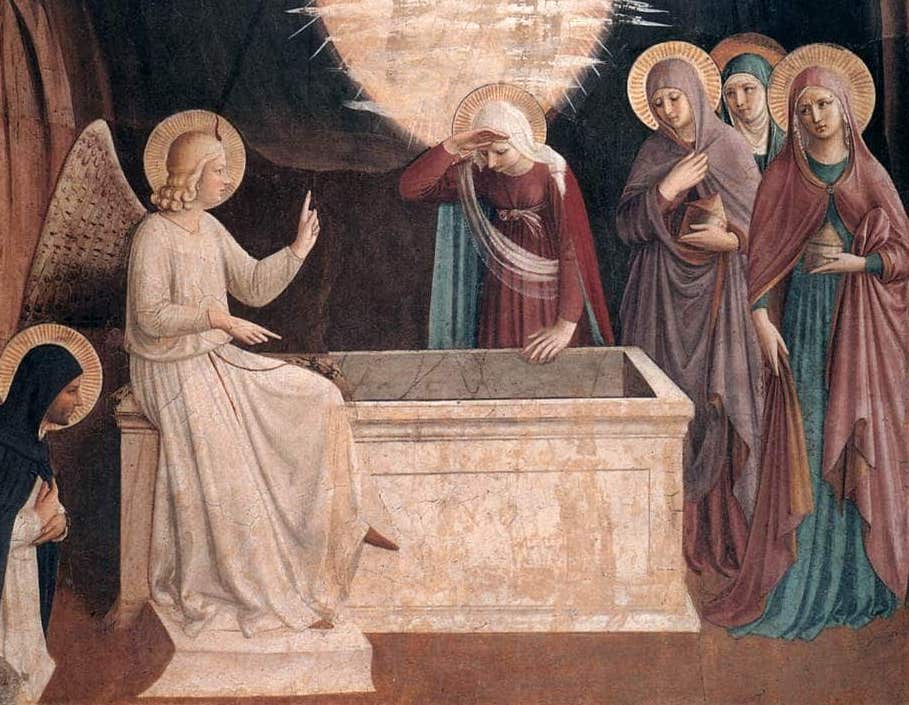
The Three Marys at the Tomb (detail), Fra Angelico, 1439–1443, Florence, Italy
 Abiding Quaker