
I knew then that w-a-t-e-r meant the wonderful cool something that was flowing over my hand. That living word awakened my soul, gave it light, hope, joy, set it free.—Helen Keller
This brief account tells of the moment in which Helen Keller apprehended reality external to herself. Though Keller became deaf and blind while she was yet a toddler, her still-intact sense of touch allowed her to experience the fluidity and coolness of water. Identifying water—and the potential to identify any other thing in existence—was not Keller’s only discovery in that glorious moment. Through this event, she grasped something that was both more basic and more far-reaching. In the flash of an instant, Keller discovered the uniquely human ability to form an idea: to know, to comprehend the correlation between her sensory perception and that which existed apart from herself. It is intriguing that Keller describes this newfound power in spiritual terms: “That living word awakened my soul, gave it light, hope, joy, set it free.”1
Keller’s discovery that material existence can be sensed; named; and ideated, that is, mentally recalled as an idea, offers us a clear analogy to what our tradition calls “the second birth” or “being born of the spirit,”2 for these are two of the names given to the sudden revelation of spiritual reality, which, once given and sensed, our natural mental powers allow us to name and call to mind. Prior to receiving a sense impression of Grace, however, we humans are as spiritually blind as Keller was physically and mentally blind: we are in a spiritual darkness that cannot see the reality of God and His Christ; nor can we accurately speculate upon the attributes of that reality, that Truth, by employing thought or the five senses, all of which are gifts bestowed by nature, the powers of the first birth.
A case can be made that Keller’s story is similar to the opening verses of the First Epistle of John, in that each tells of a new thing in consciousness that has been evoked through an impression made upon our natural faculties, the senses. In Keller’s case, it was literally the sense of touch that evoked the ascent in her awareness. Figuratively, the apostle John lists several senses (hearing, sight, and touch) that were employed in his coming to know the new thing that has appeared within. By presenting a list of sense impressions, John tells us that his testimony is as valid as testimony evidenced by the natural senses. He strengthens his testimony by listing not one but three senses, thereby claiming his testimony is not only valid but is emphatically conclusive:
That which was from the beginning, which we have heard, which we have seen with our eyes, which we have looked upon, and our hands have handled, of the Word of life (1 John 1:1).3
Interesting to note is the distinction made in the apostle’s description of the sense of sight: “which we have seen with our eyes, which we have looked upon” (1). The distinction between the “seen” and “looked upon” is not negligible: for the latter phrase is one of agency while the former is not. This telling distinction encapsulates the overall effect caused by the inward shift in consciousness: there is a movement from passive reception of the Word of life (“seen with our eyes”) to active participation: to directing the gaze with intent and mental acuity (“we have looked upon”). The writer’s juxtaposing these two states hints at—–and to the enlightened mind alludes to—the passage from the first birth and into the second, from darkness into light, from spiritual deadness into eternal life. With that light, one can see; with that life, one can move and act; and one can—and must—testify.
Additionally, in the accounts of both Keller and the apostle, the naming of the thing follows the sensing of it. Keller learns the word “water” by having its letters written on the palm of her hand; she could then tie that word to the cool flow she had felt. Likewise, the apostle at first gives no name but refers obliquely to “[t]hat which was from the beginning.”4 It is only after telling of his sensory perceptions that John gives a name to that which was perceived: “the Word of life.” In both Keller’s story and in the opening lines of this epistle, the sensation prompts the human power to name (Gen. 2:19-20).5
It is not only the act of naming that the sense experience calls forth; the apostle proceeds to tell his readers what more must follow one’s witnessing to and naming of the Word to the Church. The minister must give It context: “[we] shew unto you that eternal life, which was with the Father and was manifested unto us” (2b). No longer are we humans to be alienated from God, creatures driven from His Presence (Gen. 1:23); we are instead to be “with the Father.”
After reminding his readers that his declaration is based upon sense experience (“[t]hat which we have seen and heard”), John identifies the intent of his witness: “that ye also may have fellowship with us” (3a). John once again reminds us that his fellowship is “with the Father,” and should another person also be in fellowship “with the Father,” that other will likewise be in fellowship with John himself.6 The apostle is here identifying the true, sole qualification of those who comprise the Church: first, fellowship with the Father, “and with his Son Jesus Christ” (3b), and through that alone comes true fellowship among the members of the Church. Absent this qualification, there is no true fellowship and no true Church.
George Fox shows his agreement (and perhaps refers to this same verse) when he writes: “The true Christians’ fellowship is with the Father and with the Son, by whom all things were made and created, and all fellowships below this will come to nothing.”7 Isaac Penington notes that it is the individual soul which must be in fellowship (covenant) with God; no longer can the community be considered the entity with whom the Father joins in covenant relationship. Penington writes: “What is the New Covenant? It is a new agreement between God and the soul, different from the former agreement, which was between God and that people of the Jews.”8
Finally, the apostle concludes his introductory statements in this first epistle by telling of his intent to benefit his readers: “And these things write we unto you that your joy may be full” (4).
1. Epigraph. Keller. The Story of My Life, accessed 12/12/24,
https://www.holloway.com/g/helen-keller-the-story-of-my-life/sections/chapter-iv.
2. In this book alone, we’re given several references to spiritual birth: 2:29; 3:9; 4:7; and 5:3-4. Other books containing references to the spiritual birth include John (1:12–13; 3:3, 5-7) and 1 Peter (1:23).
3. This citation and all subsequent ones are from the King James Version.
4. The word “beginning” connotes birth or creation as well as pre-eminence (Gen. 1:1).
5. To reverse this order—to know the name without first having received the sense impression within—is to fall into the category early Friends designated as befitting the aggressive, cultural “Christians” they encountered: “professors not possessors.”
6. An example may clarify the meaning of this statement: If George is in relationship with the Father and Margaret is in relationship with the Father, then George and Margaret are in relationship with one another. Conversely, if George is in relationship with the Father, and Ross is not in relationship with the Father, then George and Ross are not in relationship with one another.
7. George Fox, The Works of George Fox (Philadelphia: Marcus T. C. Gould, 1831), 6:242.
8. Isaac Penington, Works of Isaac Penington (Farmington, Maine: Quaker Heritage Press, 1997), 4:19.
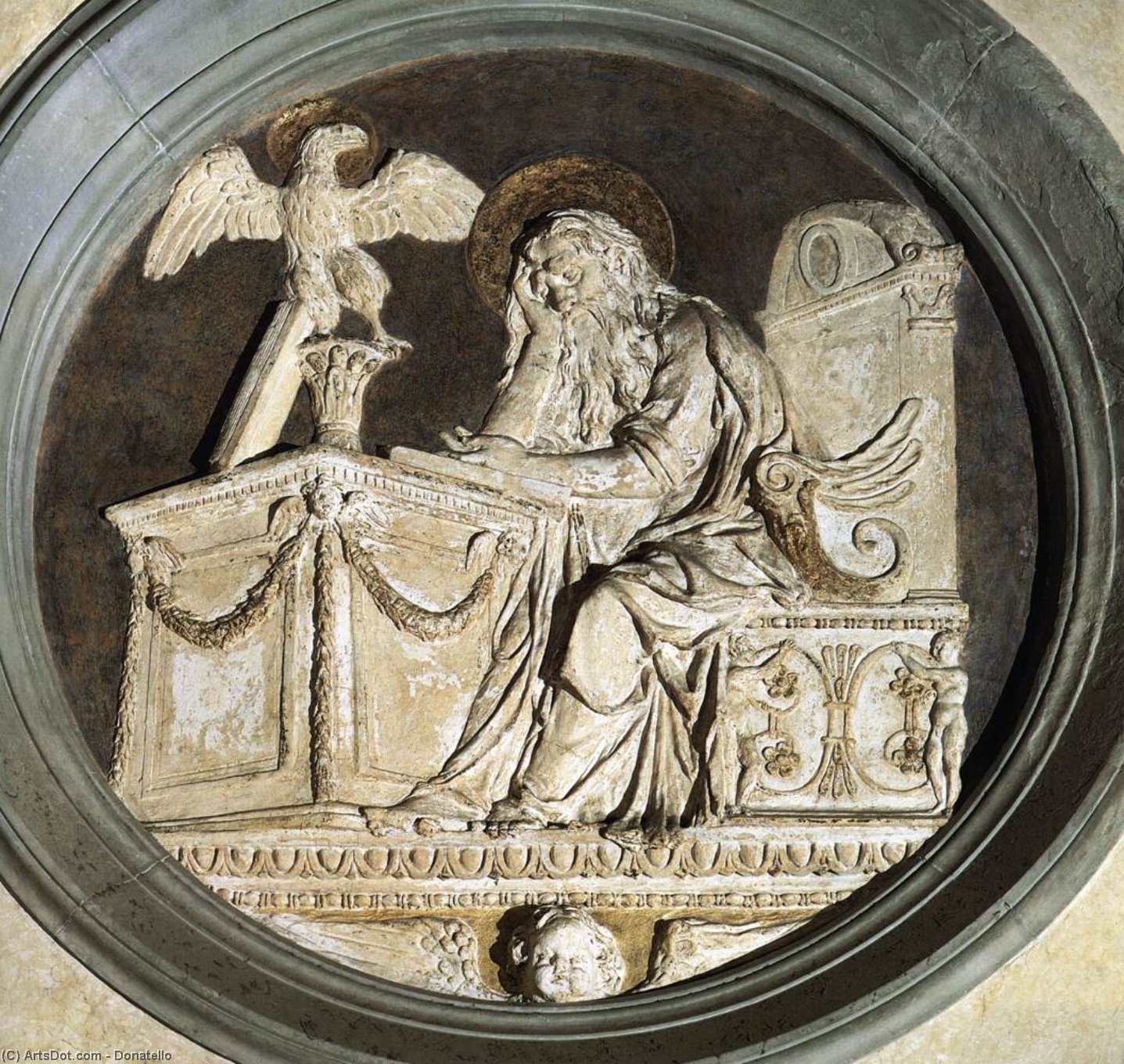
John the Evangelist, 1428 Donatello
 Abiding Quaker