
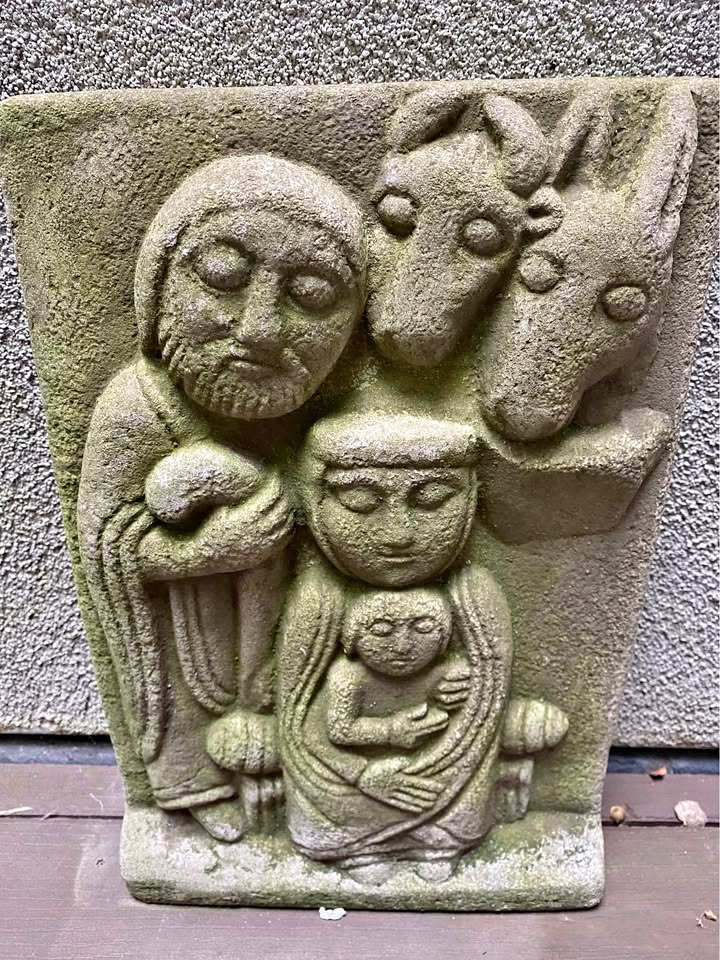
A few weeks ago, I purchased from a fellow Philadelphian a bas-relief sculpture of the Nativity. The work had been done in a simple, primitive style, showing only the essential figures: Joseph; Mary, enveloping the Christ child; and the cow and the donkey, peering in from the upper-left corner. I brought the item home, set it in a central position on a prominent piece of furniture; surrounded it with greenery; and honored it with my large, brass candlesticks, one on each side. And then I began to ruminate about explaining the significance of this set-up to my four-year-old granddaughter, who was sure to ask at our family get-together. Knowing her father and mother’s staunch opposition to the elevation of Jesus to a unique, divine status, I felt confused about how I could answer her questions without violating her parents’ desire to protect her impressionable mind from ideas which find no purchase in reason.
My son and I have always been big fans of reason, and I, who have been given faith, find no conflict at all between the two, knowing the power of each and which is the greater and which is the lesser. His regard for reason stands his soul in good stead to receive faith (as it did my own), for reason has the power somewhat to create order by subduing self-delusion and the empty, chattering demands of desire and fear. Reason thus provides a similar guide and discipline to us humans that the Law of Moses provided to the Hebrews: that is, both reason and the Law are good, preliminary standards, but neither can complete us; that is to say, neither of these tools can perfect the human soul.
Carrying into prayer my confusion about what to say to my granddaughter, I was given an overview of the Christmas story. I saw the shepherds and their fear; I saw the wise men and their seeking; I saw the parents and their nurturing of the new life; and I saw them all come together to worship the Light and Life; they came together into one place: the stable (the humble domain of animals). They all came together to worship the new life, which lifts us above our present state and into knowing Life in God.
None of the story’s participants had known this new state, and neither should we expect any that we know and love to know it any more than they who first came to the stable. We will let it stand as it is, as unknown, and remind the children only that the babe is loved, just as they are loved. That is enough.
 Abiding Quaker