
Give yourselves wholly to prayer and entreaty; pray on every occasion in the power of the Spirit (Eph. 6:18 [NEB]).
The following is a segment of text dialogue with my daughter that began during a time when her beloved cat was suffering, and we feared his long life—and their decade-and-a-half time together—was nearing its end.
Daughter: It just seems like HE or his personality isn’t in there anymore. He’s definitely quiet and low-key and stuff, but even then, he just doesn’t seem to be in there.
Even when he was agitated and possibly in pain on Thursday, the night this all started, he seemed to still be himself, even though his balance was thrown off worse then. He still looked like he recognized me, and he wanted to come to me, like his normal self.
Mom: Hard to hear this. Just love him. If you need to go to work tomorrow, I can check in on him during the day.
Daughter: I read a book by the father of an addict, and he concluded that as horrible and hard as it is for a person to go through addiction, it’s harder for the people who love the person. For the same reasons you were saying . . . . [She’s referring to an earlier conversation that day, where I’d said that in some ways, it’s easier to go through some severe difficulty oneself than to see someone you love go through it. Because with oneself, one knows what’s happening within and can sense the exact moment when the worst is over and you know you will recover. Whereas when watching someone you love suffer, one has less or no exact understanding of what’s going on within, and so feels helpless.] You just don’t know for sure what is going on and you have no control at all.
Daughter: Also, there’s a part in Moby Dick where the narrator’s best friend, Queequeg, gets really sick, and the carpenter is in the process of building him a coffin for a burial at sea. Then Melville describes that all of a sudden, after days of being really sick and preparing to die, Queequeg just “decides” he doesn’t need the coffin any more, and he’s not going to die. And the narrator talks about how strange and funny it was that the change was so abrupt, and Queequeg just knew it instantly.
Mom: Art, especially great fiction, is a source of help in many ways. So glad you read the great white whale.
Life has some unbearable suffering in it. And loving someone who is struggling, or maybe unable to struggle, toward well-being is a severe kind of emotional pain.
Daughter: Yeah. That’s what music is for.
Mom: Music is the most immediate art: goes right to the soul. I think one reason is that it comes into the body at its own pace. Other arts are outside the body and visible, so take some willingness on our part to incorporate them. Music comes into us without any choice other than to listen.
Daughter: Yeah, that’s true. That’s why music intimidates me . . . it’s on its own time schedule, and I liked a more behind-the-scenes approach to making something.
Mom: Not understanding the last text. You wanted more of a hand in creating art, and music had its own demands? When you have time, please explain.
About no choice in music’s effect on us, I think of the video clip of R___ [granddaughter], hearing music and moving her body. Here it is. [I included a video clip from early June 2022 of 10-month-old granddaughter hearing live music for the first time.] Happy-face emoji.
[Half hour later. . .]
It just occurred to me that what prayer is is to yield one’s self, so that the Spirit can enter your soul, like music that is wholly good and restorative.
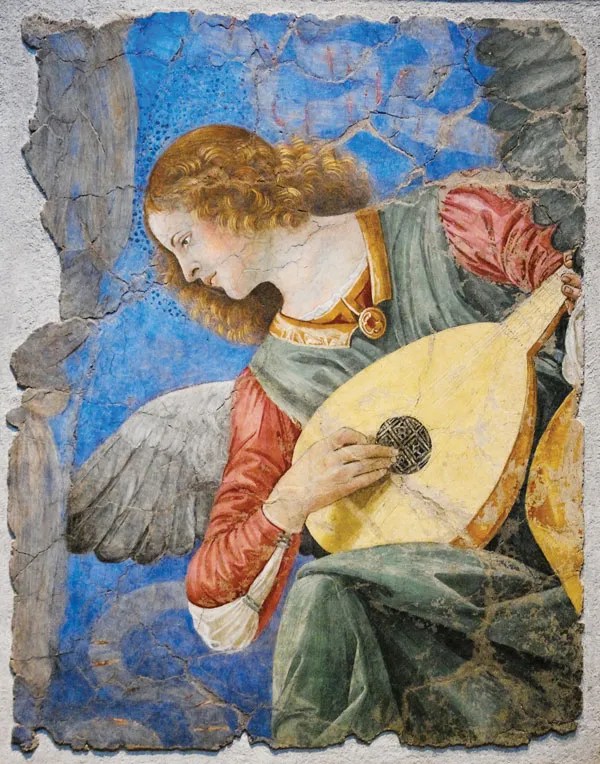
Melozzo da Forli (1438–1494) Basilica dei Santi Apostoli
 Abiding Quaker