
Yea, a sword shall pierce through thy own soul also, that the thoughts of many hearts may be revealed (Luke 2:35).
Eighteen-thousand two-hundred sixty-one days have passed since I first became a mother; that’s one day short of 50 years. On that Saturday morning, my then-husband and I drove past the Vatican on our way to Salvatore Mundi hospital in the Monte Verde section of Rome. The labor was short and intense, and though the child was in a breech position, she was delivered naturally: the octogenarian obstetrician yelling, “Femina!” while I with firm determination continued to push so that my daughter might suffer no harm while entering the world. In the hospital, one of the nurse Sisters—the kind one who brought me chamomile tea each evening—confided that all the Sisters in the nursery argued every day over who would be the one to bathe this beautiful child.
Eleven-thousand two-hundred twenty days have passed since she died (that’s more than 30 years), and I have grieved a portion of every one of them.
It has occurred to me recently that grief carried so long is perhaps “worldly,” and I should lay down this burden for one that is lighter to carry. In fact, I have considered that this grief might be admonished by Jesus’s words: “He that loveth son or daughter more than me is not worthy of me” (Matt. 10:37). To grieve so long might be to interfere with the gift of Life, with the command to preach its reality, and to model the comfort and joy of its reception. Yet, there is recognition of grief’s power in the figure of Mary, whose grief equals the suffering of the cross, as alluded to in the epigraph.
Grief does consume life, as does all suffering. And I think this is the point to examine. This first-birth life (our human nature) with its ups and downs, its suffering and its elation, its loves and hates must not consume us; rather, it is to be consumed, for the first birth in its entirety is simply the raw material, the food, for the second.
Except ye eat the flesh of the son of man and drink his blood, ye have no life in you. Whoso eateth my flesh, and drinketh my blood, hath eternal life; and I will raise him up at the last day. For my flesh is meat indeed, and my blood is drink indeed (John 6:53—54).
The flesh and blood to which Jesus alludes is figurative language for the “first birth,” also a figurative term for the nature into which we are born but must not remain “for term of life.” Jesus speaks as though it were his own particular flesh and blood that is to be eaten, but these words to his baffled disciples imply that it is their own (which is to say, it is our own) particular flesh and blood that is to be consumed and metabolized into the second, for it is only then, as Jesus tells us, that we may dwell in him and he in us (56).
Though we know suffering to have a role in the drama of our salvation, we need not go running after it, for it will surely find (and remind) us where we are. In fact, long before any catastrophe arrives, we are already half cognizant of suffering estrangement from the principle of life. By grace, we are given to see the hidden principle of God’s own life that has lain buried within, and that Seed from our earth doth grow . . . even as does the child in the womb.
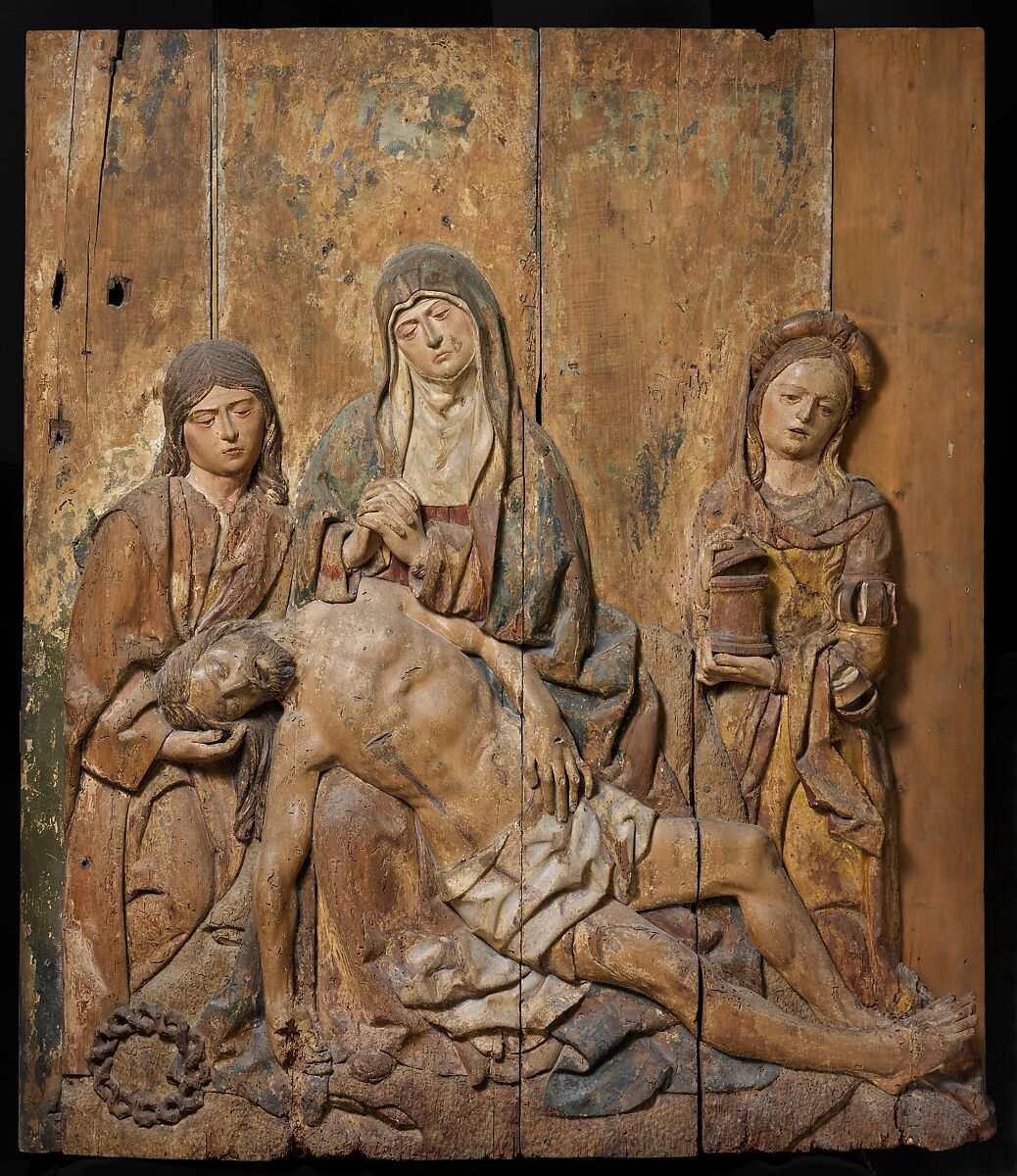
Pieta, early 16th century French, Metropolitan Museum of Art
 Abiding Quaker