Yea, a sword shall pierce through thy own soul also, that the thoughts of many hearts may be revealed (Luke 2:35).
Eighteen-thousand two-hundred sixty-one days have passed since I first became a mother; that’s one day short of 50 years. On that Saturday morning, my then-husband and I drove past the Vatican on our way to Salvatore Mundi hospital in the Monte Verde section of Rome. The labor was short and intense, and though the child was in a breech position, she was delivered naturally: the octogenarian obstetrician yelling, “Femina!” while I with firm determination continued to push so that my daughter might suffer no harm while entering the world. In the hospital, one of the nurse Sisters—the kind one who brought me chamomile tea each evening—confided that all the Sisters in the nursery argued every day over who would be the one to bathe this beautiful child.
Eleven-thousand two-hundred twenty days have passed since she died (that’s more than 30 years), and I have grieved a portion of every one of them.
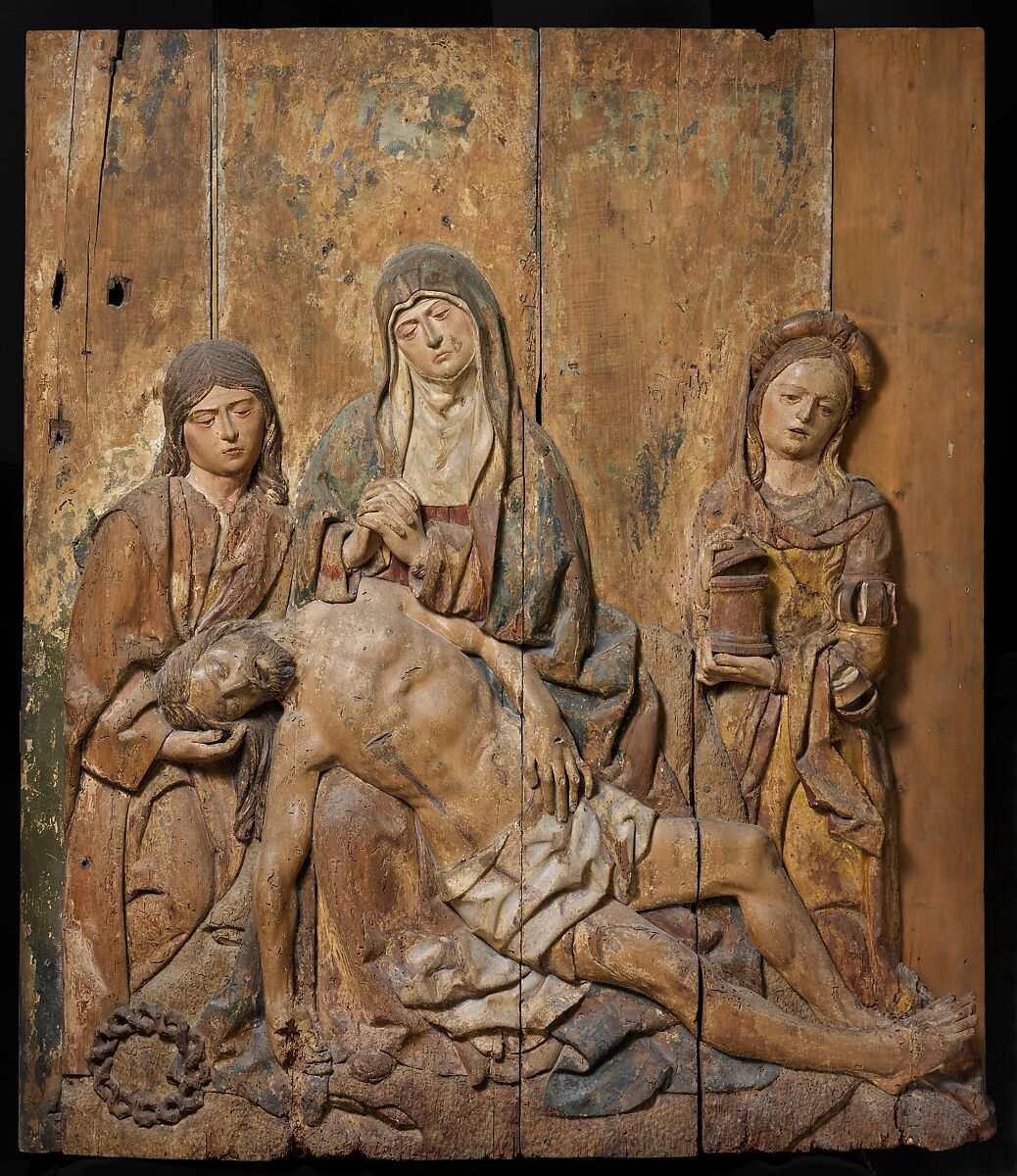
It has occurred to me recently that grief carried so long is perhaps “worldly,” and I should lay down this burden for one that is lighter to carry. In fact, I have considered that this grief might be admonished by Jesus’s words: “He that loveth son or daughter more than me is not worthy of me” (Matt. 10:37). To grieve so long might be to interfere with the gift of Life, with the command to preach its reality, and to model the comfort and joy of its reception. Yet, there is recognition of grief’s power in the figure of Mary, whose grief equals the suffering of the cross, as alluded to in the epigraph.
Grief does consume life, as does all suffering. And I think this is the point to examine. This first-birth life (our human nature) with its ups and downs, its suffering and its elation, its loves and hates must not consume us; rather, it is to be consumed, for the first birth in its entirety is simply the raw material, the food, for the second.
Except ye eat the flesh of the son of man and drink his blood, ye have no life in you. Whoso eateth my flesh, and drinketh my blood, hath eternal life; and I will raise him up at the last day. For my flesh is meat indeed, and my blood is drink indeed (John 6:53—54).
The flesh and blood to which Jesus alludes is figurative language for the “first birth,” also a figurative term for the nature into which we are born but must not remain “for term of life.” Jesus speaks as though it were his own particular flesh and blood that is to be eaten, but these words to his baffled disciples imply that it is their own (which is to say, it is our own) particular flesh and blood that is to be consumed and metabolized into the second, for it is only then, as Jesus tells us, that we may dwell in him and he in us (56). Fox wrote in his epistle 230: “[T]o know a fellowship with Christ in his death and sufferings, is above the fellowship of bread and wine” (Works, 7:244).
Though we know suffering to have a role in the drama of our salvation, we need not go running after it, for it will surely find (and remind) us where we are. In fact, long before any catastrophe arrives, we are already half cognizant of suffering estrangement from the principle of life. By grace, we are given to see the hidden principle of God’s own life that has lain buried within, and that Seed from our earth doth grow . . . even as does the child in the womb.
Pieta, early 16th century French, Metropolitan Museum of Art
Give yourselves wholly to prayer and entreaty; pray on every occasion in the power of the Spirit (Eph. 6:18 [NEB]).
The following is a segment of text dialogue with my daughter that began during a time when her beloved cat was suffering, and we feared his long life—and their decade-and-a-half time together—was nearing its end.
Daughter: It just seems like HE or his personality isn’t in there anymore. He’s definitely quiet and low-key and stuff, but even then, he just doesn’t seem to be in there.
Even when he was agitated and possibly in pain on Thursday, the night this all started, he seemed to still be himself, even though his balance was thrown off worse then. He still looked like he recognized me, and he wanted to come to me, like his normal self.
Mom: Hard to hear this. Just love him. If you need to go to work tomorrow, I can check in on him during the day.
Daughter: I read a book by the father of an addict, and he concluded that as horrible and hard as it is for a person to go through addiction, it’s harder for the people who love the person. For the same reasons you were saying . . . . [She’s referring to an earlier conversation that day, where I’d said that in some ways, it’s easier to go through some severe difficulty oneself than to see someone you love go through it. Because with oneself, one knows what’s happening within and can sense the exact moment when the worst is over and you know you will recover. Whereas when watching someone you love suffer, one has less or no exact understanding of what’s going on within, and so feels helpless.] You just don’t know for sure what is going on and you have no control at all.
Daughter: Also, there’s a part in Moby Dick where the narrator’s best friend, Queequeg, gets really sick, and the carpenter is in the process of building him a coffin for a burial at sea. Then Melville describes that all of a sudden, after days of being really sick and preparing to die, Queequeg just “decides” he doesn’t need the coffin any more, and he’s not going to die. And the narrator talks about how strange and funny it was that the change was so abrupt, and Queequeg just knew it instantly.
Mom: Art, especially great fiction, is a source of help in many ways. So glad you read the great white whale.
Life has some unbearable suffering in it. And loving someone who is struggling, or maybe unable to struggle, toward well-being is a severe kind of emotional pain.
Daughter: Yeah. That’s what music is for.
Mom: Music is the most immediate art: goes right to the soul. I think one reason is that it comes into the body at its own pace. Other arts are outside the body and visible, so take some willingness on our part to incorporate them. Music comes into us without any choice other than to listen.
Daughter: Yeah, that’s true. That’s why music intimidates me . . . it’s on its own time schedule, and I liked a more behind-the-scenes approach to making something.
Mom: Not understanding the last text. You wanted more of a hand in creating art, and music had its own demands? When you have time, please explain.
About no choice in music’s effect on us, I think of the video clip of R___ [granddaughter], hearing music and moving her body. Here it is. [I included a video clip from early June 2022 of 10-month-old granddaughter hearing live music for the first time.] Happy-face emoji.
[Half hour later. . .]
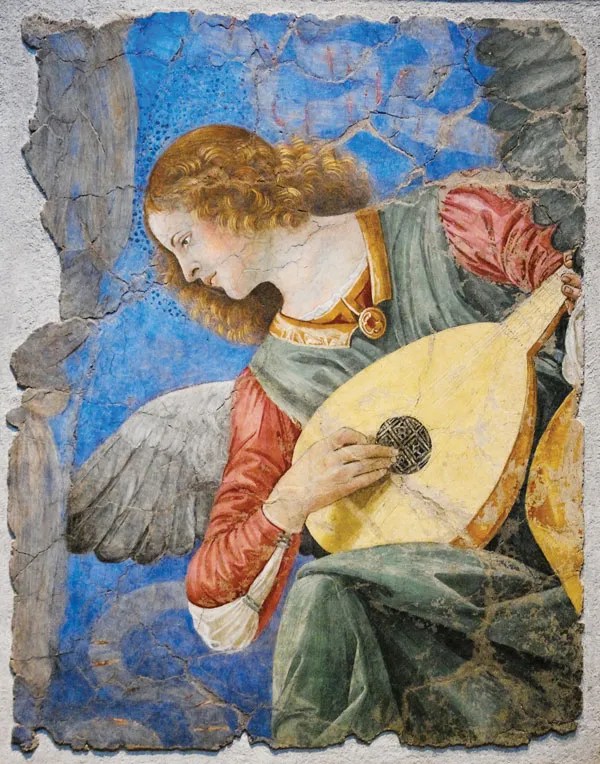
It just occurred to me that what prayer is is to yield one’s self, so that the Spirit can enter your soul, like music that is wholly good and restorative.
Melozzo da Forli (1438–1494) Basilica dei Santi Apostoli
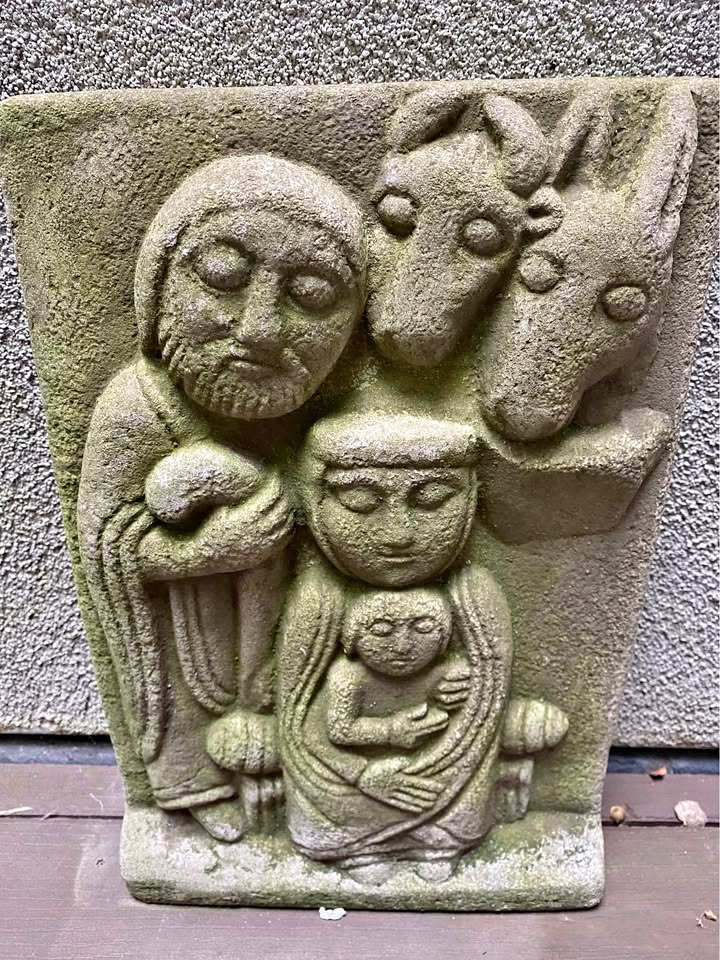
A few weeks ago, I purchased from a fellow Philadelphian a bas-relief sculpture of the Nativity. The work had been done in a simple, primitive style, showing only the essential figures: Joseph; Mary, enveloping the Christ child; and the cow and the donkey, peering in from the upper-left corner. I brought the item home, set it in a central position on a prominent piece of furniture; surrounded it with greenery; and honored it with my large, brass candlesticks, one on each side. And then I began to ruminate about explaining the significance of this set-up to my four-year-old granddaughter, who was sure to ask at our family get-together. Knowing her father and mother’s staunch opposition to the elevation of Jesus to a unique, divine status, I felt confused about how I could answer her questions without violating her parents’ desire to protect her impressionable mind from ideas which find no purchase in reason.
My son and I have always been big fans of reason, and I, who have been given faith, find no conflict at all between the two, knowing the power of each and which is the greater and which is the lesser. His regard for reason stands his soul in good stead to receive faith (as it did my own), for reason has the power somewhat to create order by subduing self-delusion and the empty, chattering demands of desire and fear. Reason thus provides a similar guide and discipline to us humans that the Law of Moses provided to the Hebrews: that is, both reason and the Law are good, preliminary standards, but neither can complete us; that is to say, neither of these tools can perfect the human soul.
Carrying into prayer my confusion about what to say to my granddaughter, I was given an overview of the Christmas story. I saw the shepherds and their fear; I saw the wise men and their seeking; I saw the parents and their nurturing of the new life; and I saw them all come together to worship the Light and Life; they came together into one place: the stable (the humble domain of animals). They all came together to worship the new life, which lifts us above our present state and into knowing Life in God.
None of the story’s participants had known this new state, and neither should we expect any that we know and love to know it any more than they who first came to the stable. We will let it stand as it is, as unknown, and remind the children only that the babe is loved, just as they are loved. That is enough.
Every summer my granddaughter and her mother travel to northern Michigan to visit family and to escape the heat of Philadelphia’s July and August. It is always a joy when they return in early September and the family gets together. A few days ago, my son and granddaughter stopped by for lunch after a morning trip to the city zoo. Midafternoon, we decided a jaunt to a nearby playground was in order, and we began the short walk from my home. A minute into the walk, my granddaughter—now four years old—took my hand in hers and said that when we got to the corner, we’d need to hold hands because we were going to cross the street. I felt a little surprised at this, as it seemed such a short time ago that she needed to be reminded of this precaution. She had learned in the last two months that every street crossing required an adult’s hand, and she was even taking the initiative to ensure that she followed the rule. She had integrated this idea into her understanding of what is the right thing to do.
This little sign of maturation stayed with me, and I began to ruminate on how we humans each structure our understanding of “what is right,” beginning when we are toddlers and continuing into adulthood. We structure ourselves according to what we find to be right for us as individuals and according to socio-cultural guidelines: sometimes the two in concert and sometimes in contradiction.
We stand by our inward formation of righteousness, having tested its utility and honed its shape until it yields a reliable, sustainable guide to our daily life. Do I drink coffee every morning? Of course! Drinking coffee in the morning is good; I’ve been doing it for decades, and my morning’s routine gives structure to my day. This and ten million other choices over the decades have engineered my personal way of being in the world and have contributed to the stability of my personality, allowing me to affirm myself in what might be called a comfortable and politely hidden sense of self-righteousness. Nothing out of the ordinary, it’s just human nature: necessary and useful. With time, however, this reliance upon the constructed self, with its accompanying sense of righteousness, fails and must be transcended.
__________
For they being ignorant of God’s righteousness, and going about to establish their own righteousness, have not submitted themselves unto the righteousness of God (Rom. 10:3).
In this verse, Paul states the problem, and he then sets out to distinguish two different kinds of righteousness: (1) our own righteousness and (2) the righteousness of God. He does this by referring to the first kind of righteousness as “the righteousness which is of the law” (10:5) and the second kind as being “the righteousness which is of faith” (10:6).
Now the law of Moses that these Roman Jews—to whom Paul writes—would have seen as the guiding guarantor of righteousness is one of those many things that can be adopted to structure our understanding of what is right. Because it is adopted, however, it is therefore in the same category as every other idea that can be adopted, such as the idea that it is right to take an adult’s hand to cross the street; that it is right to drink coffee at the start of the day; that it is right to honor and extol the traditions of religion; or that it is right to be concerned for the welfare of our fellow beings. Major or minor, each decision and expression contributes to our personal sense of righteousness and thus to ourselves as righteous and good. Paul presents this self-affirming righteousness as being distinct from “the righteousness which is of faith.”
The Jews to whom Paul is writing are also deemed “called of Jesus Christ” (1:6). Paul therefore undertakes to clarify for them the way Christ is to be known: he tells them that the righteousness of faith that is of Christ will not be found in their prior knowledge of him and all that he did and is, for that knowledge can be retrieved by calling it to mind; whereas the righteousness of faith is not retrievable. Christ, the Word, is nowhere to be retrieved: neither from heaven (6); nor from “the deep” (7); nor from thought, emotion, memory, nor from the tradition’s keeping: that is to say, the Word is not to be found in the Scriptures or traditions of religion. Rather, it is in your mouth and in your heart (8).
By announcing the word of faith is to be in the mouth and heart (9–10), Paul respectively stresses the Word’s immediacy and convincing power, which, when experienced, cannot but lead to knowledge of, trust in, and confession to Jesus’s lordship. Those who live responsive to the commands of “the Lord our Righteousness” (Jer. 23:6) will exhibit a righteousness that replaces their previously constructed lifetime’s compendium of what is right. No longer regarding the former inventory of righteousness as fully reliable renders us flexible to amendment. We are keenly aware of our own personal inability to know the right, and yet we are enabled to partake in the perfection of the righteous One: a state that allows worldly defeat to coexist with heavenly victory (8:36—37) and a genuine humility to go hand-in-hand with jubilant exaltation.
_____________
In our country’s politics, a rigid opposition exists between groups professing conflicting ideas of what is right: one side claims the Christian religion is its unimpeachable authority, and the other side claims its authority to be the humanistic values that have their roots in Christian history. In the public sphere, neither side puts forth the faith Paul extols in this tenth chapter of Romans, the righteousness of faith: for the one retrieves its faith from Christian religion but often lacks its values, and the other trusts in the values of but often disdains the Christian religion.
No cobbling together of the two halves can engineer true righteousness (though that solution may have passed muster in times past). For righteousness does not result from staking one’s claim inside the boundary of thought (theologically identified as “the world”) but will instead appear to those who have long worked the land within those worldly boundaries and, in truth, found it barren wasteland.
To the yet unknown abundance, the prophets point: they teach abundant life is not gained upon the rungs of aspiration but through the spontaneous cry of anguish (13) that arises in the heart that has too long endured the dry, barren spaces of the world-bound self. “I was found of them that sought me not; I was made manifest unto them that asked not after me” (20).
Our politicians give us what we want; that’s how they get elected. The time has come for us American people to reconsider our responsibility for our society: If we truly want good governance, a forward movement toward justice, then, as individuals, we each must see the flaws within our personal and group claims to righteousness. This honesty would be a step to ready us to receive the righteousness of faith that Paul describes in this passage in Romans 10, a faith that provides us with a sense of what is right, which yields different results from the ideologies that have informed us thus far. Not the “religion” of Christianity nor the philosophy of humanism but a new, profound awareness of the righteousness of faith can foster unity in the body politic.
For there is no difference between the Jew and the Greek: for the same Lord over all is rich unto all that call upon him (12).
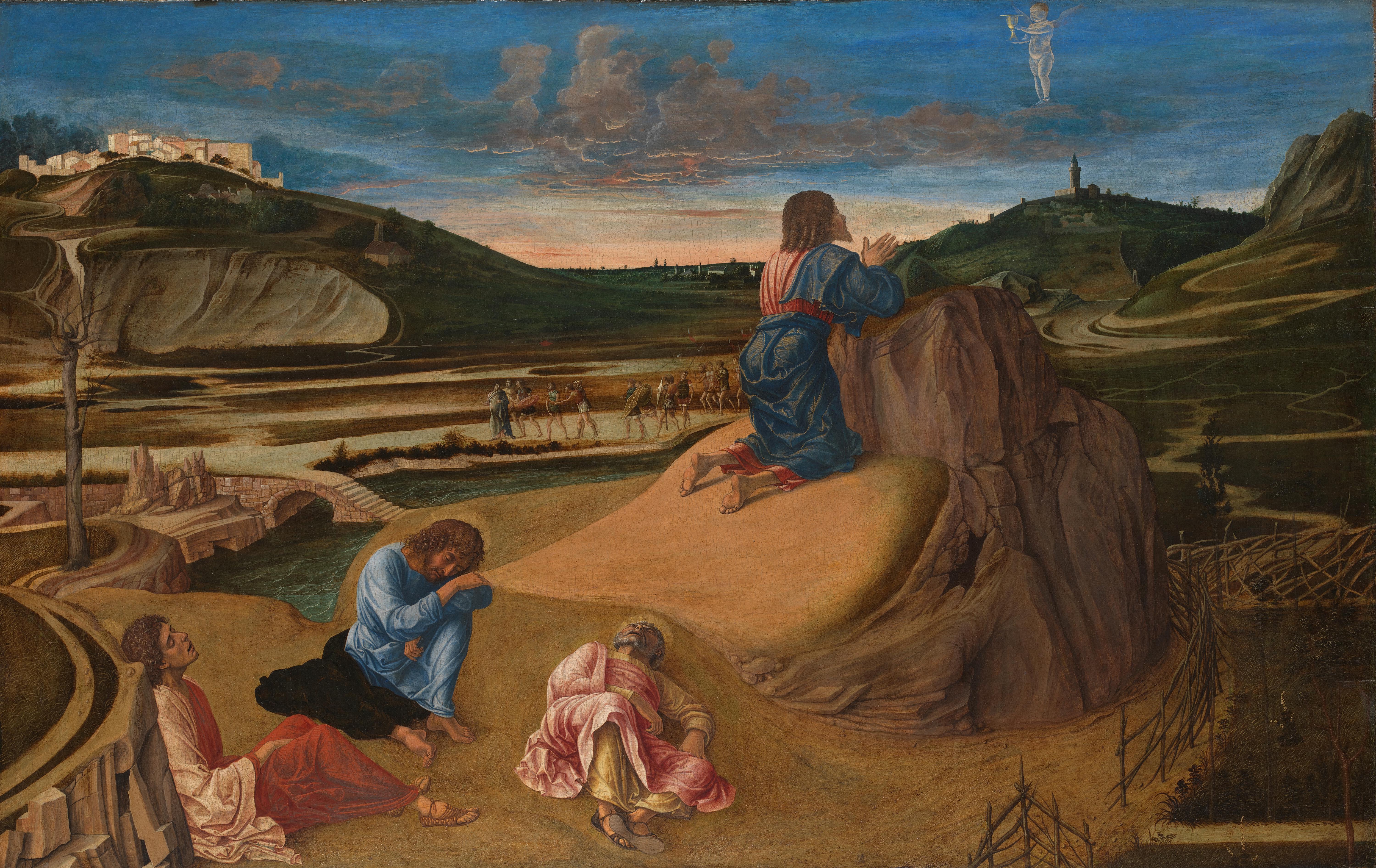
Agony in the Garden by Giovanni Bellini, 1459–1465
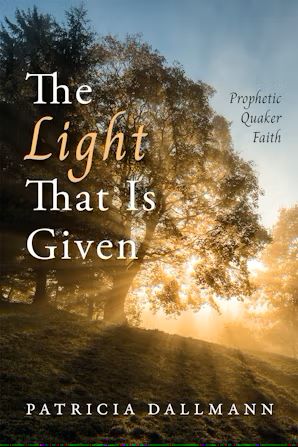
I am pleased to announce the publication of my latest book, A Quaker Reading of Mark’s Gospel: To See the Invisible. This volume of essays was written mostly between the summer of 2022 and early this year, and much of its content has appeared here at Abiding Quaker. As with my last book, The Light That Is Given: Prophetic Quaker Faith, this book was published by Wipf & Stock Publishers and can be purchased from their site, as well as from bookstores and online sites. Links can be found in the “About” page in the blog’s menu.
Below you can find the book description that is featured on the back cover, a few editorial reviews, and an image of the front cover, which happily bears resemblance to the one created for the earlier book. In each, light figures prominently in a landscape: gloriously breaking through to illuminate vision and reveal the truth of nature’s forms. Once again, the illustrators at Wipf & Stock have excelled in their choice of visual metaphor to portray both the content and intent of the work: to affirm Light is come into the world!
Book Description
In story after story and chapter after chapter of Mark’s Gospel, Patricia Dallmann approaches the text with senses attuned to the Light Within, an orientation in keeping with that of seventeenth-century Friends (Quakers). Though in accord with the faith and message of these first Friends, Dallmann offers insights that are original and, at times, accompanied by illustrations from her own life. Mark’s Gospel is seen to be a practical guide that stands ready in every age to alert those of living faith to the dangers they will face, the responsibilities they must assume, and the Spirit they will embody while navigating their passage through the world. Mindful of the inward reality to which the Gospel alludes, Dallmann provides paths of understanding that have been found in Truth and are presented with reason. Thus, readers will find this book to be a clear, sound, and useful examination of the Gospel of Mark.
Editorial reviews
Early Quakers claimed to read and understand the Bible differently from others in mid-17th c. England. George Fox, in particular, spoke of “figures”—what we might call “metaphors”—and the critical importance of reading Scripture with the same Spirit that had given it forth. Patricia Dallmann has taken the Gospel of Mark and walks us through it, verse by verse, explaining the “figures” that reflect our own internal spiritual condition. She accompanies the explanations with appropriate quotations from early Friends. The result presents a vital and living Quaker way of understanding the life and teachings of Jesus.
—Marty Grundy, Quaker writer
I so enjoyed Dallmann’s A Quaker Reading of Mark’s Gospel that I often balked when someone disturbed me. Pat’s comments on the biblical text clarify the particular passages and identify their underlying relationships, tracing patterns that offered me another layer of guidance for my spiritual life. Her sprinkling of vignettes from her own experience balanced my reaction between the excitement of new understanding and the validation of personal example. I am eager for my second reading.
—Susan Smith, Former Clerk, Ohio Yearly Meeting
Patricia Dallmann’s commentary on the Gospel of Mark offers a spiritually insightful, figurative reading of the text. Drawing on Quaker tradition, she emphasizes inward transformation through the Spirit of Christ rather than outward law or ideals. Dallmann critiques literal and intellectual interpretations, urging readers to seek personal, experiential knowledge of God. Her chapter-by-chapter analysis highlights themes of unity, suffering, discipleship, and inner renewal, presenting Jesus as teacher, Messiah, and the source of spiritual wholeness.
—Charles Martin, Former Publisher, Inner Light Books
Midway through my daily walk, I realized that I’d forgotten the large glass of water that I drink before setting out each morning. As a result, I was feeling parched as I ambled along on this last-day-of-July morning of the hottest year on record. The bodily thirst corresponded to the frame of mind that had been occupying my thought throughout the walk: the longing for the refreshing Presence of Christ Within. As I was treading along in this state of both physical and spiritual thirst, the first two verses from Psalm 42 (KJV) came to mind:
As the hart panteth after the water brooks, so panteth my soul after thee, O God. My soul thirsteth for God, for the living God: when shall I come and appear before God?
I feel personal connection to these words, not only because they create an image that illustrates my soul’s profound longing for God, but also because the deer (hart) has been the animal I’ve felt closest to and the one that has figured, now and then, significantly in my life. I suppose that if I were a Native American, the deer would be my totem animal!
So I was delighted when earlier this week, I read of a fourth-century mosaic that depicted deer quenching their thirst at a fountain placed at the base of the Cross. The essay in which this description occurred is titled “Why We Need the Creed,” written by Erik Varden, the bishop of Trondheim, Norway. The mosaic he described is located in the apse of a prominent church in Rome, St. John Lateran. Taken from his essay, Bishop Varden’s description follows:
The image of Christ found there is like a pictorial precis of the Nicene definitions. Surrounded by angels, Christ is depicted in heavenly realms as a haloed torso suspended between, underneath, a naked cross, the emblem of his work in time, and above, a seraphic composition that symbolises the Father’s eternal throne. The Spirit, in the form of a diving dove, connects Christ’s apparition in glory with the earthly sphere, causing rivulets of water to gush down along the cross’s stem to form at its base, a fountain from which deer quench their thirst and around which sheep pasture.
It is always gratifying to find imagery from past millennia that correlates with one’s inmost experience and discoveries, as both the psalm and the mosaic did in their depiction of the deer drinking the living water. The great lapse of time since the image and words were created did not diminish their relevance. For from age to age, time has no bearing on innate human nature with its universal, profound need, within which every particular person awaits the one, eternal resolution.
Images and words furnish each inward life just as one furnishes one’s home with domestic furniture and utensils. These externals can order and nurture our daily life: providing utility; comfort; beauty; and, most important, a sense of home. In like manner, the inward life is ordered and nurtured by words and images that allow us to feel at home, peaceful and content: known. Having thus furnished the inward habitation, we trust that when he appears, the Christ will find our soul to be a beautiful, hospitable, and familiar place of rest.
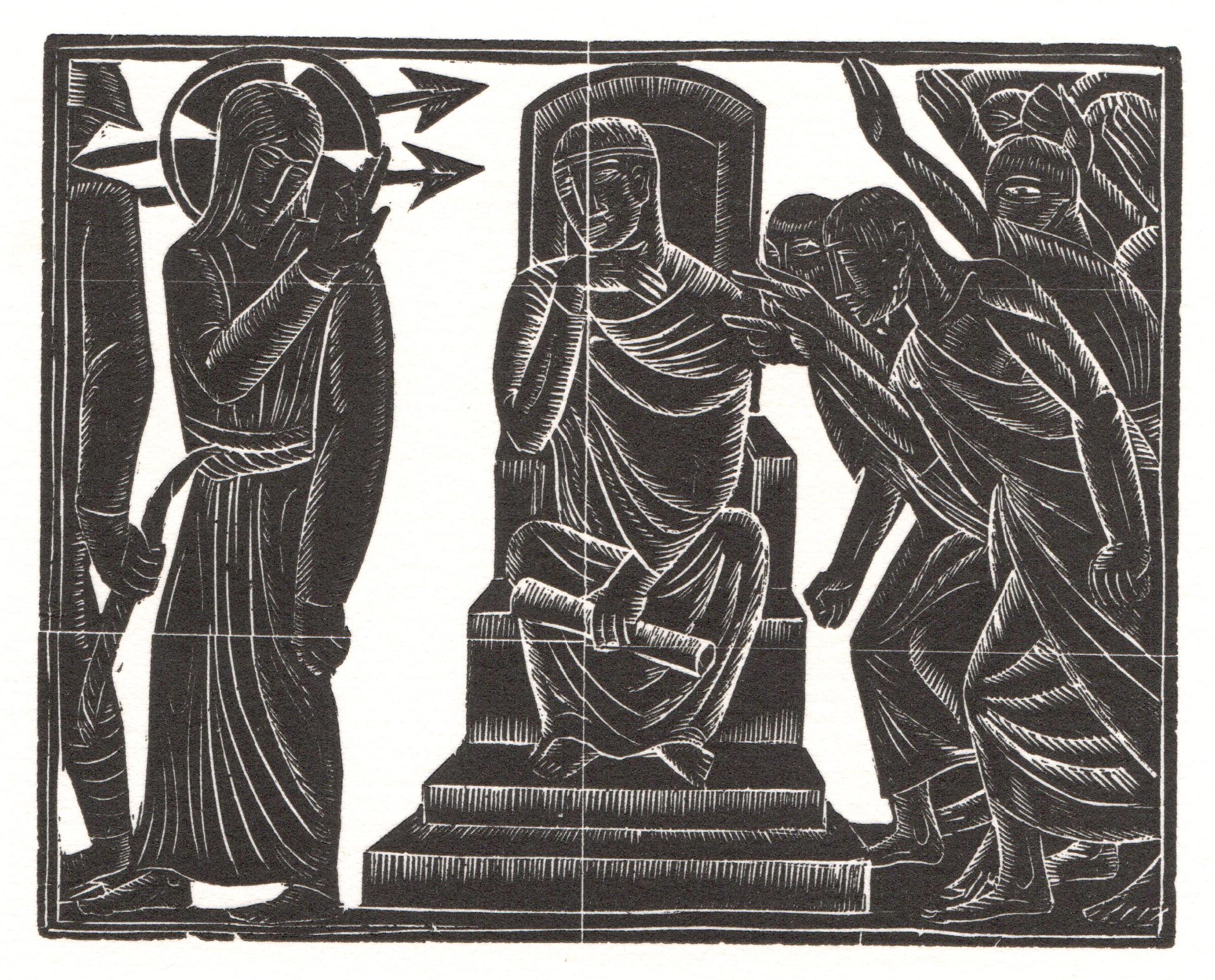
At the festival season it was the Governor’s custom to release one prisoner chosen by the people. There was then in custody a man of some notoriety, called Jesus Bar-Abbas. When they were assembled Pilate said to them, ‘Which would you like me to release to you––Jesus Bar-Abbas, or Jesus called Messiah?’ For he knew that it was out of malice that they had brought Jesus before him (Matt 27:15–18 [NEB]).
In the New English Bible version of Matthew’s Gospel, “Jesus” is given as Barabbas’s first name. In Aramaic, his last name, “Bar-Abbas,” means “son of the father.”[1] In this story, only one Jesus, son of the father, will be chosen to live. It is likewise true that in each of our own lives, we, also, must choose one of the two spirits that are respectively embodied in these men. Whom will we choose: the spirit of Barabbas or the spirit of Christ? Which of the two spirits will animate and guide our life? Which of the two will have free rein in the heart? Which spirit—each with the same name and claim to entitlement—will live within? Will it be the one the world (the crowd) chooses, or will it be the one who must first die to the world?
Who is Barabbas?
All four Gospels mention Barabbas, but their descriptions vary: Matthew tells us that he was a “man of some notoriety”; Mark and Luke refer to him as a rebel and a murderer; and John calls him “a bandit.”[2] How we view Barabbas––freedom fighter or robber––does not alter the fact that his was a life engaged in the exercise of worldly power.
To be under the thrall of a foreign nation or to crave wealth settles as a wound on a person’s pride and leaves him with a weakened sense of himself. Against suffering the untenable state of a diminished self-image, Barabbas rebelled, and in attacking his fellow beings, he attempted to regain that self-regard. By overpowering others, taking their lives, property, or political authority, he could see himself as strong, i.e., as comparatively stronger. That this malicious dynamic is true wherever the worldly sensibility resides is confirmed not only by experience—historical, political, and personal—but also in the anchoring verse of this passage, spoken of one who is worldly and more crafty than noble: “For he [Pilate] knew that it was out of malice that they had brought Jesus before him” (18).
Barabbas’s true oppressor was not the Roman Empire nor his own lust for wealth; that oppressor was, in fact, his own fear of facing the truth of his existential condition, his fundamental inability to make life tolerable for himself. This universal human problem can be temporarily relieved by the acquisition and exercise of power, especially power over others. It is eternally relieved, however, only by means of courageously sustaining a regard for truth, though it leads to an impassable chasm where we teeter on the brink, stare into darkened depths, and faithfully endure in cross-like intensity.
“Do you refuse to speak to me?” said Pilate. Surely you know that I have authority to release you, and I have authority to crucify you?’ “You would have no authority at all over me, Jesus replied, if it had not been granted you from above” (John 19:10–11a).
For the word “authority,” substitute the word “power” in this exchange between Pilate and Jesus, and we have the quintessential showdown between the worldly and the heavenly sensibilities. It is the heavenly that has the final word, the final power: it is not the spirit of Pilate nor of Barabbas. Regardless of their differing worldly status, each had the worldly spirit: rebelling against and robbing both God and himself of his true nature as son of God.
Conclusion
In a recent meeting for worship, a Friend spoke of a problem that may come with knowing the stories of Scripture: this knowledge of the Bible can lead to crediting ourselves with more wisdom than is warranted. The ministering Friend used the story of Barabbas and Jesus standing before Pilate and the Passover crowd as an example. It was easy, he said, to criticize the crowd for choosing Barabbas over Jesus as the prisoner to be released, as we already knew the story. He asked us to consider if it was our knowledge the Bible story that led us to think that the choice was obvious. If we had been in that Jerusalem crowd and not known the story, what choice would we have made; whom would we have chosen to go free?
We can find the answer in self-reflection. Do we attack when we feel our self-image has been besmirched by another? Is the acquisition and retention of authority/power the impetus for our life? Do we trust the Father of life and his power to sustain our sense of personal worth, our sense of life, regardless of outward circumstance? Do we choose Jesus, Son of the Father, to be released and live free within our soul?
[1] Rees, T. “Barabbas.” International Standard Bible Encyclopaedia 1:402.
[2] Descriptions are found in Matt 27:16; Mark 15:7; Luke 23:19; and John 18.40. I’ve used the New English Bible in this essay.
Our Isaac Penington Study Group has now completed the 34th and final session of a 17-month study of Penington’s tract “Some of the Mysteries of God’s Kingdom Glanced At.” On the 26th of last month, we began to read a tract written by James Nayler, another seventeenth-century Friend. The tract is titled “The Lamb’s War against the Man of Sin.”[1] Because we are now studying Nayler and not Penington, I have changed the title of the YouTube channel to “Early Quaker Study Group.”
In this first session–beginning around the 19-minute mark and ending around the 50-minute mark–is a discussion on the nature of this war, as it is found among Quakers today; the necessity of individual responsibility; and the way this war can be waged. The title of this first discussion is “Nayler, Session #1, 3/26/25.”
Index and Contact Pages
This month marks nine years that I’ve been blogging here at Abiding Quaker, and as the essays are catalogued on the main page only by the month in which they were posted, locating a particular piece can be difficult. As a result, I have created a new page in the menu that contains an index that lists essay titles in alphabetical order. Each title is linked to its essay, so access should be quick and easy.
This past week a person from a Middle Eastern country became a subscriber, and as he was the first from that particular country ever to visit the site (according to the statistics that the web provider offers), I was elated and spoke to my daughter about wishing I could know more about what drew readers to the site and what interested them most about Quaker faith. She suggested I create a Guest Book and ask these questions, but that is beyond my technical ability at present. If anyone would care to answer these questions, however, there is room to do so on the Contact page. No pressure though!
The Works of James Nayler, vol.4, pp.1-21 Farmington, Maine: Quaker Heritage Press, 2003-2009.
Detail of Adoration of the Mystic Lamb, 1432 Hubert van Eyck and Jan van Eyck
The March issue of Friends Journal has a review of my book The Light That Is Given: Prophetic Quaker Faith that was published last June by Wipf and Stock Publishers, their Resource Publications imprint. I appreciate Marty Grundy’s thoughtful, knowledgeable evaluation of my work and have excerpted the final two paragraphs from her writing and copied them below. The full review can be found online here: https://www.friendsjournal.org/book/the-light-that-is-given-prophetic-quaker-faith/
Dallmann draws on the Bible and early Friends’ writings . . . as authentic witness to the Truth as testified to across time and culture. To this she adds her own witness to the Truth. . . . Her message is that we are to “know experientially the only true God, and Jesus Christ, whom he has sent, whom he raised from the dead, the one in whom we live, and move, and have our being.” This is declared to be the Truth of prophetic Christian faith known by Paul, early Friends, Lewis Benson, and Swiss theologian Emil Brunner, among a host of other witnesses.
As Dallmann found inadequate the human-inspired and human-directed efforts to make Quakerism more palatable to modern Western folks, she invites readers to taste what she has found. The book will not be an easy read for many Friends of any of our branches. But that does not mean it is not an important book to read, ponder, and be open to experiencing its Truth. If we want to reclaim and live into the power of early Friends . . . Dallmann’s The Light That Is Given is a good place to begin.
So . . . they that are in old Adam are old creatures; and are in their old things, old ways, old worships, and old religions, and have the old garments, and the old bottles, that hold the old wine, and cannot endure the new; and have the old, rusty, moth-eaten treasure. And they that are in Christ, the heavenly and spiritual second Adam, who maketh all things new, are new creatures, and spiritual men, and are heavenly-minded, and are new bottles, that hold the new wine and the new heavenly treasure, and have the new clothing, the fine linen, the righteousness of Christ, and are the new and living way, over all the dead ways.—George Fox
Although the warning Jesus gives his disciples to “beware of the leaven of the Pharisees” will not appear in this book for another six chapters (Mark 8:15), it is in this chapter, chapter 2, that we are given several examples of this false form of spiritual edification, along with Jesus’s opposition to and correction of the error.1 In this essay, I will be examining the chapter’s conflicts one-by-one to show how Jesus challenges the misuse of the tradition by which the religious authorities hinder the very thing the tradition was intended to foster, i.e. the spiritual rising to life in Christ. At the end of the essay, I will touch upon the appearance of this same problem in modern-day Quakerism.
Hearing the call (13-14)
The first scene in this chapter positions Jesus at the seaside: a vast, undifferentiated landscape where he teaches a vast, undifferentiated multitude. One verse later, the scene has shifted: Jesus is walking along, and he sees and calls an individual. It is a tax collector, one recognized by all as separate from society. “Follow me,” Jesus says to Levi, the son of Alphaeus, and the man, named and individuated, “arose and followed him” (14). The lesson to be taken from the first two verses in this passage is Christ teaches the multitude, but it is the individual whom he calls to follow him, i.e. to find and take up his way of being. Each person—we are being told—must locate and follow the truth within his own heart, regardless of the personal or social ramifications that surely will follow. He or she must honor the integrity of his God-given soul and reject the stance that he is justified by unsubstantiated, traditional ideas or by fitting into his social group. Those who do so will fail to hear the Light, Jesus Christ’s transcendent call within to follow him.
Needing the physician (15-17)
In verses 15 through 17, the setting has moved to the house of the called one, where “many publicans and sinners” who “followed” Jesus dine with him and his disciples. Here near the start of his ministry, Jesus’s conflict with institutional religion shows itself: the religious authorities imply that eating with publicans and sinners is a violation. Jesus disregards not Mosaic Law but the “tradition of the elders” (7:3): religious precepts long held necessary for righteous life.2 Jesus responds to the Pharisees’ challenge:
They that are whole have no need of the physician, but they that are sick: I came not to call the righteous, but sinners to repentance (17).
In but a few words, Jesus not only sets out his healing mission (introducing the metaphors of health for salvation and sickness for sin) but rebukes those who proudly, erroneously refuse to see their own soul’s sickness (their unrighteousness), and thus exempt themselves from recognizing their need of the physician. Only the humble self-aware who feel their alienation from God (i.e. sin) will welcome the physician’s care and thus be restored to health and wholeness.
Isaac Penington spoke of “the physician [who] is come inwardly and spiritually”3 when he wrote the following:
the broken and humble-hearted ones (who have felt the inward power of life to change their natures, and to preserve them in that which God hath begotten in them), the grace prevaileth to save in every dispensation.4
For seventeenth-century Friends, the willingness to recognize the truth of one’s inward condition was the crucial requirement through which the soul was prepared for salvation.
Again, Penington describes Jesus Christ and his work:
[H]e inwardly heals and restoreth his people, faithfully seeking after the sick, the distressed, the broken, the wounded; pouring oil into their wounds, and healing them. But there are some who are so sound and whole in their notional apprehensions and practices, that they have no need of the physician, and them the physician passeth by, as unworthy of him, and whom he intendeth shall have no share with him. “Ephraim is joined to idols” (he is well, he hath enough, he hath no need of me) “let him alone,” saith the Lord.5
The Bridegroom (18-22)
In this passage, the authorities reproach Jesus for lack of holiness by calling attention to his disciples’ failure to fast, as do their own disciples and those of John the Baptist (18). Implied is their assumption that fasting, or asceticism, evinces holiness. Rather than downplaying his disciples lack of ascetic practice, Jesus capitalizes on it: By referring to himself as “the bridegroom” (19), he alludes to the wedding ceremony where feasting, not fasting, is in order. Jesus’s use of the bridegroom metaphor would rile the authorities further in that it would suggest to them that Jesus was making himself equal to God. For in their Scriptures, “bridegroom” was used metaphorically to signal God’s relationship to the soul: “[A]s the bridegroom rejoiceth over the bride, so shall thy God rejoice over thee” (Isa 62:5b).
In speaking immediately after of “a piece of new cloth on an old garment” (21), Jesus appears to continue his reference to Isaiah, where in 61:10, the prophet refers both to the marriage ceremony and to “the garments of salvation” (italics mine):
I will greatly rejoice in the Lord, my soul shall be joyful in my God; for he hath clothed me with the garments of salvation, he hath covered me with the robe of righteousness, as a bridegroom decketh himself with ornaments, and as a bride adorneth herself with her jewels.
As do the religious authorities, Jesus knows the tradition. He uses his knowledge, however, more deftly than they because he understands the true intent and purpose of the tradition and thus goes beyond their mere retention of its words and history.
Priorities (23–28)
The final episode in this chapter features many of the same circumstances that have already been reviewed in this essay: the Pharisees challenge Jesus for his disciples’ failure to honor the tradition (24), and Jesus retorts by showing not only knowledge of the tradition but his superior, irrefutable understanding of its intent and function (27). The tradition’s intent has always been to prepare souls for unity with God, which unity is a person’s health and salvation. The tradition was never to be an end in itself: a stand-alone prescription for righteousness that the religious authorities have made of it. The last verse in this chapter presents the maxim that shows the precedence given to the salvation of man—to become “the Son of man”—over traditional practices, such as the sabbath, that were put in place as a means to that end: “the Son of man is Lord also of the sabbath” (28).
For religious communities to make secondary principles and virtues their guidelines for righteousness is a human tendency that extends throughout history, and so Jesus’s exposure and correction, as shown in Mark 2, is needed in every age. In our own Quaker communities, such erroneous principles take the form of what Lewis Benson called “cults”: “the cult of love and good will,” “the cult of the Power of Non-violence,” and “the Cult of the Beloved Community” being a few examples that Benson identifies.6 These take precedence over the call to truth and righteousness that must be promoted, as the Discipline of Ohio Yearly Meeting (Conservative) states.7 Before truth and righteousness can be promoted, however, they must be sought, known, and followed—as Levi followed Jesus in this passage (14). Devotion to secondary principles that supplant the pursuit of truth and righteousness—such as notional ideals of peace, love, and community—is shown to be idolatry when challenged by the writings of Scripture or seventeenth-century Friends writings. Those who idolize the virtue of love ironically exhibit the greatest enmity when challenged and, like the Pharisees, will often conspire against those who honor truth. Laid bare, the foundation of their faith is found to be not the God of Truth but the aspiration to replace Him with their own notional ideals.
Yes, peace, love, and community are fine qualities and valued among Christians and Quakers, but they must be authentically received, a consequence of coming into the knowledge of God; they cannot be attained through man’s aspiration, which can only be a facsimile that is rooted in pride, to “be as gods, knowing good and evil” (Gen 3:5).
To know and honestly admit to one’s state is the essential thing: has one known that Spirit of Christ or has one not known that Spirit? This is an essential act of discernment that requires a truthfulness that too many in Quaker communities would prefer not to venture into, and so they don’t. The prophet helps others to see when that essential self-reflection has not yet been undertaken, as Jesus shows the Pharisees and scribes in this passage. In any age, those who undertake the same work can expect the same resistance and personal attacks that Christ’s prophets have always endured.
The Christians formerly (in the first day of the breaking forth of God’s power) had Christ in them, the living Word; they opened their hearts to him, received him in, felt him there, found him made of God to them their wisdom, their righteousness, their sanctification, their redemption. They had the thing that those words signify and speak of, and knew the meaning of the words by feeling of the thing. But Christians now, in the apostasy, have got several apprehensions from the words, without feeling the thing the words speak of; and there lies their religion. And now the heir is come, holding forth the thing they have all been talking of, all sects upon the earth are mad against him, and would fain kill him. They would not have the living substance . . . but they would have their dead apprehensions from the words live, and their dead forms and practices owned; and the heir of life must come in their way . . . or they will not own him.8
1 Epigraph. Fox, Works 8:157. The King James Version is used throughout this essay.
2 “The Greek word . . . translates “a giving over,” either by word of mouth or in writing; then that which is given over, i.e. tradition, the teaching that is handed down from one to another. The word does not occur in the Hebrew Old Testament (except . . . [when] used in another sense . . . ) but is found 13 times in the New Testament . . . . It means, in Jewish theology, the oral teachings of the elders (distinguished ancestors from Moses on) which were reverenced by the late Jews equally with the written teachings of the Old Testament, and were regarded by them as equally authoritative on matters of belief and conduct. . . . [These include] some oral laws of Moses (as they supposed) given by the great lawgiver in addition to the written laws. (The International Standard BibleEncyclopedia, vol.5, ed. James Orr and company (Grand Rapids, Mich. Wm B. Eerdmans Publishing Co., 1939), p. 3004.
3 Penington, Works 3:278.
4 Penington, Works 2:349.
5 Penington, Works 3:278.
6 Wallace, None, 56–58. Benson writes: “They are all notions and collectively they absorb and deflect the interest, energy, and devotion that should be conserved and redirected if we are to fulfill the purpose for which God called us to be a people.” None Were So Clear, ed. T.H.S. Wallace. Camp Hill, PA: New Foundation, 1996, (56–58).
7 “Make it your aim to promote the cause of truth and righteousness, and to spread the Kingdom of God at home and abroad. Be ready to take your part fearlessly in declaring His message and in witnessing to His power” (Ohio Yearly Meeting [Conserviative] Advise 13.) https://ohioyearlymeeting.org/wp-content/uploads/2023/12/Advices.pdf Accessed 1/20/25.





 Abiding Quaker