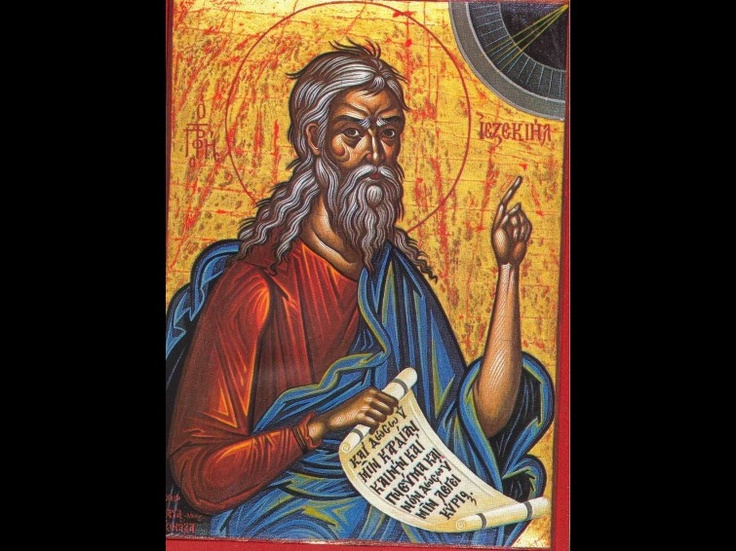
The following is my response to Evan Knappenberger’s writing, which can be found in part 1, posted yesterday on this blog. Our discussion pertained to chapter 36 in the book of Ezekiel in which two verses, 30 and 31, tie together God’s blessing of increased harvest and riddance of the heathens’ reproach with the Israelites coming awareness of shame. Our discussion is an attempt to understand this mixed blessing within the context of the forward movement of humanity towards salvation. We find affirmation in our Quaker tradition that being “led by the Holy Ghost into the truth and substance of the Scriptures” requires our “duly applying them to [our] own state[s]” (Nickalls, 31-32).
Patricia writes:
Thank you, Evan, for revisiting your ministry and going into your thoughts around “mixed blessing.” On First Day, I felt the importance of your words but wasn’t clear to respond. There are several ideas that I’m still struggling with and the act of writing will, I hope, allow me to clarify.
First, I’ll say that I agree with the idea that there’s a “mixed blessing” that is comprised of God’s plenitude and the self-awareness of shame. Shame is a topic that figures crucially into humanity’s restoration, and thus it shows up in the story of the garden with Adam hiding himself because he was naked (Gen. 3:10) and concludes with the “finisher of our faith ” who despised the shame of the cross (Heb. 12:2).
The passage in Ezekiel documents God’s correcting the people’s error that shame stems from the reproach of others (the “heathen” [KJV]) to a corrected understanding: that shame is the direct result of a broken relationship with God and the inevitable hiding from that truth [Gen. 3: 8–10] and that shame accompanies failed autonomy. The Ezekiel passage returns the source of shame from the social arena (which is worldly) to its true location where it is found in honest introspection, an inward facing of the truth of oneself. Verses 30 and 31 show the changeover from one to the other (italics mine):
And I will multiply the fruit of the tree, and the increase of the field, that ye shall receive no more reproach of famine among the heathen. Then shall ye remember your own evil ways, and your doings that were not good, and shall lothe yourselves in your own sight for your iniquities and for your abominations” (Eze. 36:30-31).
Shame arrived at through introspection—rather than outward reproach from the heathen—is a step forward in self-awareness, but the communal/tribal focus of this teaching that occurs in this chapter is not the end goal, and I think that the arguments God uses (I provide you with what you want [29-30]; I’m doing this to reveal my holiness [22]; and I will change you inwardly for the better [26]) conflates worldly goods with spiritual goods. As a result, the Israelites can learn to associate the unknown spiritual goods as being beneficial, as are the known worldly goods. The prophet’s teaching must raise humanity’s awareness until we are prepared individually to be restored to God: this further refinement in understanding—from communal to individual–must occur but doesn’t show up in this Ezekiel passage or largely in the Old Testament, while it instead features abundantly in the New Testament. Penington clearly states that the relationship that is now to be is not based in on the tribe/community but is personal, to be between God and the individual:
What is the New Covenant? It is a new agreement between God and the soul, different from the former agreement, which was between God and that people of the Jews (Works, 4:19).
In the Ezekiel chapter, God is teaching the people that His abundance and acknowledgement of shame go together, are inseparable. The abundance precedes shame in this passage; at a future time, however, the acknowledged shame will precede Grace, which is not available until we, individually, worship the truth by opening up to it, and that will entail shame. I think you’re in agreement with me about the primacy of the individual conscience, as you wrote the following words:
The human conscience is responsive to God’s call and is as varied in content as God’s voice to each person. The real shame is not in how we acquired our wealth, our land or whatever, but in how . . . we have put various idols—church, politics, belief —in place of the immediate conscientiousness demanded of us.
I’d say that this passage is about some rudimentary teaching that God is doing through Ezekiel, so the people learn that the inward state must be recognized and acknowledged. Outward goods, though important, are not the sum total of man’s concern. The required introspection exercises and strengthens the power of spiritual discernment, which will be necessary to see the light that shines in the darkness and enlightens every one that comes into the world.
As is often the case in worship at Seekers’ Haven, Evan Knappenberger’s ministry last week (12/22/24) was insightful and evocative. Frequently the half hour following worship allows for discussion that centers on the ministry that’s occurred, but this day Evan had brought forward a Bible passage that was less familiar and contained complex ideas that we did not feel ready to discuss, though I had a very strong sense that the topic was important and needed to be understood. Within the next couple of days, I had emailed Evan and asked him “to identify the passage in Ezekiel [that the ministry had rested upon] and paraphrase [his] ministry and the thoughts on the topic that [he’d] had since.” Within another couple of days, Evan had sent me the information and his thoughts on chapter 36 of Ezekiel, and so began our email discussion.
At Evan’s suggestion, I intend to post the significant parts of this discussion here at Abiding Quaker. I expect to do so over a few days, as both his and my emails are too lengthy to be included in one post alone. From Evan Knappenberger comes Part 1 of this short series titled “Shame and the Mixed Blessing.”
Evan wrote:
As I was sitting in meeting this last first day, the verse came to me which is from Ezekiel Ch. 36, viz v. 26, “I will give you a new heart and a new mind. I will take away your stubborn heart of stone and give you an obedient heart” (GNT) or, if you prefer, King James Version: “A new heart also will I give you, and a new spirit will I put within you: and I will take away the stony heart out of your flesh, and I will give you an heart of flesh.”
As it has been some years since I read that passage, I was led to open a Bible and find it. As is my usual practice of opening the scriptures during meeting, I was led to look for context and for the spirit to reveal itself in the text just a little bit. Re-reading the entire 36th Chapter of Ezekiel was instructive.
Clearly God is telling the prophet that he plans to bless the exilic people of Israel, to bring them back together in their own land, and to multiply them and their flocks, to reinstate them as nation in a holy tradition. It would have been easy enough for the prophets of the exile to foretell this happy and most welcome reversal of their misfortune; for who does not readily cheer such good news that confirms us in all our patriotic and ethnocentric splendor? Many a post-nationalistic modern Friend might glance at Ezekiel (or Nehemiah or Ezra, for that matter) [and] might thus be put off by this seeming promise of fundamentalist resurgence: the sureness of political and tribal domination over the “heathen” (vv. 3, 5), for example, which the prophet delivers excitedly with repetitions of “Thus saith the Lord!” Has Thee heard? We are to be shamed no more but will prosper against all our neighbors!
And here precisely is where Ezekiel cuts short the celebratory self-congratulation. “I am not,” saith the Lord God of Israel, “doing this for your sake!” What’s that? How can this be? It is not our intrinsic virtue, our ethnic heritage, our cultural superiority, our pure cultus, our direct back line to David, our insistence on the Mosaic Law which has promised to deliver us. What then, how did we earn our salvation? By what virtue have we enticed Yahweh to heed our pleas? By none! “But for my name’s sake, which you have profaned among the heathen!” (v. 22)
Yahweh’s blessing upon those exiled Israelites is not contingent upon their own goodness, works, or purity. In fact, God is telling them plainly, you have failed even in exile—you have profaned my name; you have made me another idol among many; you have polluted the world with more filth (v. 25) rather than fulfilling your purpose of being a blessing to all the nations of the earth (recall God’s promise to Abraham). The Lord is going to do all these good things to you in spite of your failure and not for the sake of your pleasure, power, or plenitude, but in verses 26 and 27, the promise is much deeper: I will cleanse you from all this and give you new hearts of flesh.
Typically, Quakers might understand tenderheartedness and “hearts of flesh” in terms of conscientiousness, responsiveness to the tender mercies and leadings of the Lord who saved Jacob and Joseph and Abraham, who we also understand to be even He who saved George Fox and Margaret Fell and Friends of His down through the current day. This verse is the golden capstone of the pinnacle of God’s promise of restoration, by which we can understand the entire purpose of Yahweh’s setting apart of the people of Jacob: namely, to establish a politics of godliness and mercy and conscience on Earth as it is in Heaven. There is indeed much to wonder at in this passage.
But the chapter, the prophecy, [and] the story do not end there. Ezekiel reiterates God’s promises of plenitude and blessing to Israel. And then [there’s] something incredible. In verses 31 and 32, we hear:
Then shall ye remember your own evil ways, and your doings that were not good, and shall lothe yourselves in your own sight for your iniquities and for your abominations. Not for your sakes do I this, saith the Lord GOD, be it known unto you: be ashamed and confounded for your own ways, O house of Israel.
What is this? Shame? What kind of blessing includes shame? Old Testament notions of blessing have never included this in their notional purview before: when Jacob steals the paternal blessing, for example, there is no explicit shame laid on him and his descendants for it. There has to this point in the Hebrew Bible been no such thing as a “mixed blessing.”
In effect, [with] the inclusion in the text of these two verses, the introduction of a complication to the notion of blessing itself within the narrative of the fulfillment of the primal Blessing, we are forced to reckon [that along] with the psychological reality of plenitude and restoration [comes] a hard and unrelenting feeling of Shame. Not just shame, but confoundedness and even loathing!
This warning of shame is to be the result of God’s blessing, not directly but as a byproduct of the plenitude of God’s goodness. It is there, surely, in the filthy abomination of idolatry in which the exiles have been struggling but has heretofore been unacknowledged among them by reason of their stoneheartedness.
When I was a soldier in the war in Iraq, we did some shameful things and justified them out of necessity: Yes, we killed those civilians, but we had to. Yes, we entrapped those people to their deaths, but it was necessary if not good. Yes, we mistreated detainees, and so on. It was only later, when we returned to the land of plenty, and went out to spend our pay on various vices that we began to comprehend the darkness of our own actions, and then only with encouragement and in the absence of other means of immoral coping.
We in America have been the recipients of much plenitude. Do we connect it with the shame of its origins? I don’t mean land acknowledgments, which have become rather formulaic recently, or even really any form of activism. There is no set form of tenderheartedness. The human conscience is responsive to God’s call and is as varied in content as God’s voice to each person. The real shame is not in how we acquired our wealth, our land, or whatever, but in how we have failed to perform God’s mission in the world; how we have failed to bring about the Kingdom of Conscience on Earth; how we have put various idols—church, politics, belief—in place of the immediate conscientiousness demanded of us.
I have no answers here, and I did not deliver all this long of a message in meeting. But for the sake of the Friends, sister Patricia Dallmann has asked me to elaborate, and this is for all Friends. Yes, there will be moments of inevitable shame and confoundedness, and that is okay. To be expected. But that is not the end of the story, and though we are given many good things and though we are washed clean by the Spirit again and again, we must wrestle with Yahweh for a mixed blessing.
E.K. Knappenberger
Ezekiel in the Valley of the Dry Bones, 1956, Benno Elkan (1877–1960)
Prayer is wholly out of the will of the creature, wholly out of the time of the creature, wholly out of the power of the creature, in the Spirit of the Father, who is the fountain of life, and giveth forth breathings of life to his child at his pleasure. –Isaac Penington
This past week I received an email from someone who had recently discovered this blog and, as a result, also had visited the YouTube channel where there are recorded sessions of our Isaac Penington Study Group.1 He had listened to the 24th session in which our small group had discussed “prayer.” In his email, this reader had offered some of his thoughts on prayer, describing it as “a state of being. . . . a living in the Life,” and he went on to summarize: “prayer is receptivity to the operations of the Spirit on our being.”
I felt hesitant to accept his thoughtsunconditionally andproceeded to identifythe reason behind my hesitation:
Although receptivity to the Spiritis one element occurring in prayer,it does not follow that all receptivity to the Spirit’s work on our beingisprayer. Prayer is a heightened state of communion with God where one’s inward being is filled with the Light of Christ. This state is distinct from our normal day-to-day consciousness in which we may live with a fear of God, meaning a knowledge and reliance upon Christ, the sure foundation of our life. If the transcendent state and daily consciousness are run together—as if there were no distinction between them—then a problem may develop: the transcendent may be reduced tosomething less than it is and normal consciousness conflated with and raised up into something more than can be legitimately claimed, which was the first and is the ever-present temptation.
Intending to explain and support my reason in my response to this person,I copieda passage from Fox’s Journal in which he describes his“veiled” consciousness, that is, when he doesn’t see Christ present yet nevertheless feelsfirmly grounded in him. Fox writes:
And when at any time my condition was veiled, my secret belief was stayed firm, and hope underneath held me as an anchor in the bottom of the sea; and anchored my immortal soul to its Bishop, causing it to swim above the sea, the world where all the raging waves, foul weather, tempests, and temptations are.2
(My response continued.)How this state that Fox describes here differs from prayer is that a person can sense (have a “secret belief”) that he is grounded and preserved by Christ and therefore feel hope, while yet attending to all the various distractions and requirements necessitated by daily existence. In prayer, however, one’s eye is single, and, as a result, one’s whole body is full of light (Matt. 6:22). Prayer is a very focused (single-eyed) activity that brings one into an exalted (Light-filled) state. Jesus often goes to a mountain to pray (Mt. 14:23; Lk. 6:12; Mk. 6:46), and this is a way of saying he ascends into a different space spiritually as well as literally. The Transfiguaration occurs following Jesus’s and the disciples’ ascent up the mountain; it is there that Jesus appears full of light, which is different from the state Fox describes as his “veiled” condition. So, you see I distinguish between my daily condition where I must attend to many things (distracted, veiled) while still feeling constantly undergirded by the Bishop of my soul, on the one hand, and, on the other, the high, focused, unveiled, Light-filled state of prayer.
The following is a transcript of a portion of the Penington Study Group’s discussion on prayer, Session #24. This segment of the discussion (31:10) looks at the Lord’s Prayer as a means to prepare one to be lifted from regular consciousness into spiritual awareness. The transcript has been edited lightly for clarity. The complete discussion can be heard here:
I think it’s significant that Jesus gives us a prayer to say in the Lord’s Prayer, and how this can be a transition or a fulcrum for moving into that wordless waiting upon the Lord. Those few verses function as a pathway, and what I find is thatthey allow me—as I focus on the words—to concentrate my attention in a way that is the state the mind needs to be in, in order to be in that open, waiting state. I think I’ve said this before here, but I find that I intensely focus upon each phrase and proceedthrough the prayer phrase by phrase. My intent is tofeel that each phrasehas been incorporated into my mind, so that my mind is focused and has made meaning of that phrase: that I’ve come into contact with the meaning of it. You know how you can say words, and there isn’t meaning, but sometimes when you say words, there is meaning. So what we’re looking for in that process is to get a strong sense of meaning in the words that we are saying.
One time my family was visiting a Quaker up in Maine, a Quaker family up in Maine, and there wasn’t any meeting nearby so whenSunday came, we went to a Baptist church, and in that service the minister led the congregation in reciting the Lord’s Prayer in unison.We all stood up, and we all began to say the Lord’s Prayer. My daughter, who was about seven at that time, pulled me down so that she could whisper in my ear, and she said, “They sound like zombies.”And they did, because there was there was no life in in those words that were being said; there was no meaning; it was just a recitation of words that everybody was familiar with and nobody was putting any meaning into them.
I think how this Lord’s Prayer can help us is that if we take each phrase and just focus on it so intensely, the meaning comes to us.And when each phrase has had that happen, then we move to the next phrase; and we proceed through that prayer one phrase at a time, allowing it to gather meaning for us. I find that by the time I get to the end of that prayer, it’s like I am lifted off from the world into a spiritual realm where there are no words, but there’s just Spirit: it’s almost like being launched into a spiritual place.Those words in that prayer are arranged to help us move from our normal frame of mind into a place that we can receive God, that we’re prepared to receive God.All we can do is prepare, and that prayer does do that.
Another part of that process for me is if I lose my concentration in any of those verses, I feel morally obligated to go back to the beginning and start over. There needs to be a sustained concentration, because at the end of it what we are is just focused concentration waiting, and what works against us is our distractions: ourtendency to become distracted.So what we want to do is concentrate and focus, and the difficulty is that we’re not focusing on a particular object or a particular thing; we’re focused on waiting, so it becomes that we’re focused on an absence of object.
Epigraph. Penington, Works, 2:345. Isaac Penington Study Group, 9/18/24, YouTube.
Nickalls, Journal, 14.
St. Francis Receiving the Stigmata, Jan Van Eyck, c. 1438
This post includes an email exchange with Evan Knappenberger, a Friend with whom I regularly worship at the Seekers’ Haven Worship Group, a Conservative Friends online group that meets each First-day morning for worship. Evan is a graduate student, an Iraq war veteran, and has two degrees in theology. He often ministers in our worship sessions, and I am always led to listen closely, because he speaks with sincerity and a sense of the faith. Evan’s contribution to this post is a story about two Trump canvassers who appear on the protagonist’s doorstep one October afternoon and the response given to them. Evan sent the story to a local newspaper and to me, asking for my response, which is copied after the story.
Evan’s writing begins:
Dealing With Fascism at Your Door: A Friendly City Primer
By E.K. Knappenberger
for the Harrisonburg Citizen, 10/24/2024
It was 4:30 on a warm October Harrisonburg afternoon, and I was just sitting down to my 900-level university creative writing workshop on zoom, when the doorbell rang. The dogs immediately went nuts. Annoyed, I got up thinking that some important business was at hand. I was right, but not in the way I expected.
When I opened the door and stepped outside, two pasty, rotund old ladies were standing there with Trump literature. “Hello!” they tried to sound cheerful but they looked exhausted, “I’m Betty and this is Linda. We want you to vote republican.” They pushed some glitzy propaganda in my face.
My first reaction, which I suppressed successfully, was to hiss, to rant, or to confront. Like many people who are not in the cult of the spray tan Mammon, I find the presence of the (somewhat more rare than last time) Trump signs and stickers to be a threat to everything that I hold dear as an American and as a Christian. Because of their convict-idol’s rhetoric of violence, which has explicitly called for the imprisonment and execution of those of us who helped the democratic party, it is not unreasonable to feel threatened by the mere presence of trumpian hate speech. The little old ladies walking around our town, who are by many reputable press accounts paid by shadowy post-Citizens United billionaire cash contributions, represent something much more sinister than appearances suggest.
Precisely because the self-described wannabe dictator has said repeatedly that anyone who stands in the way of his “extreme power” will face violent “bloody” consequences, I myself (along with the majority of my fellow Harrisonburgians who refuse to consent to authoritarian takeover of the federal government) have been forced to grapple with the hard truth that, like many countries on the brink of massive political violence in the past, one third of America would likely exterminate another third of America, while the last third did nothing to stop it from happening. Betty and Linda, despite their benign-seeming presence on our Harrisonburg front porches, whether they know it or not, are harbingers of death. I can say this as a historian, but also as a combat veteran and former intelligence analyst who witnessed a genocide up close. Every moral fiber in me revolts in disgust from watching such people advocate their death cult among the good people in our land of putative freedom.
My friend Sofia Samatar, in her beautiful meditations perambulating the Friendly City, recently wrote in her column describing the reactionary violence of a deranged diner at Capital Ale House, who verbally assaulted her children for purely political reasons. What does one do in such situations? What can one do against such pernicious, deep seated evil? As a Christian and as a thinking person I offer the following template, a Friendly City primer on telling off those trumpian idolaters who spread their evil in our little corner of the world. A template of certain terms and theological language that no true Christian can deny. Let me also add that one needn’t be a believing Christian to engage in the kind of theological argumentation below — Lord knows, there are scant few believing Christians among the Trump idolaters. But of course, it helps to be familiar with the New Testament to make a convincing argument as I have suggested below.
“Betty, Linda,” you can say with some practice, “I am glad that God has led you here for us to learn something today. Pray with me.” You can take their hands if you want, bow your head, and screw your eyes up tight. Before they can start talking, continue in a tone approaching prayerfulness.
“Lord, we know that you sent your only begotten Son, Jesus, so that we might not perish but have eternal life. We know this from the Gospel of John, chapter three, Lord. You told us that Christ Was, in the beginning, before the creation of the world, that he Was and Is and always Will Be your holy Word. We know that from John chapter one.”
Take a deep breath but don’t wait too long. Continue.
“Almighty God, we know that your Living Word Jesus Christ is the Truth, by whom alone we are sanctified (John chapter 17 verse 17); and that the Truth alone can set us free in body and in spirit (John chapter 8, verse 32). Heavenly father, we know that Jesus left us the Holy Spirit, who is an Advocate of God’s Truth (John 14:16) who alone can defend us and whom alone we should trust.”
Here you can begin to build your prayer louder so that all your neighbors can hear. Continue in power with conviction if possible.
“We also know that to blaspheme this Holy Spirit of Truth is an unpardonable sin. (Mark 3:28, Matt 12:31, Luke 12:10). Lord, we know that lies alone such as Trump makes every day, are a sin; but we confess to you Lord that when we blaspheme the spirit of Truth itself, as Trump also does daily, we are assaulting the very nature of our God’s goodness, freedom and aid. We are bothered, Lord, when worldly leaders like Trump lie openly, and even moreso when they expect the Truth to conform to their unholy word.”
“We are perplexed when trumpian apologists ask, like Pontius Pilate, “what even is truth?” (John 18:38). But Lord, we are utterly confounded when the idolaters of Trump, like the pharisees who sought to murder your Word made Flesh, act in order to destroy every notion of what is true and what is false. (John 7 through 9). Help us to repent, Lord, of the blasphemous notion that Trump’s satanic lies are little white ones! Help us recant the diabolical assertion that while Trump is often factually incorrect, that he is still somehow correct in spirit, or in orientation. This, we confess to you, all-knowing God, is the blasphemy of placing Satan’s lies on the altar of your Truth.”
“In the name of Christ, we renounce the demons in Betty and in Linda and in all those possessed by the spirit of lies. We repent their worship of a false idol on their TV screens. Almighty one, save us, drive the lie-loving power-hungry exploitative ones who mislead these little old ladies into a lake of fire (Rev. 20:10) as you have promised. Father, do not wait to save us from the falseness of those who blaspheme and who seek the death of your servants (Psalm 38).
“How long, Adonai, will you suffer your Truth to be trampled and devoured by lying, unclean hypocrites? (Matt 7:6). But save us, let your Truth set these deceived ones free, and deliver us from the evil of Trump and his satanic snares, as you have promised. Take these two women, God. Turn their rotten hearts toward you, O Lord! Open their scaly eyes and teach them to stop causing others to stumble! Force them to unbind their deformed consciences, Lord! Chastise them that they might be saved from the evil they think they want to commit in the name of Trump!”
Let go of Betty’s and Linda’s hands, but before they can respond, say quickly “Go and sin no more! ” and be sure not to slam the door too hard in their faces.
Patricia wrote:
Thanks for this, Evan. I think you have zeroed in on the main issue: the avalanche of deceit that has been the mainstay of Trump’s public performance these past eight years. There are plenty of other behaviors that make him offensive, but the continual violation of truth is—as you have written—to “blaspheme the spirit of Truth itself . . . [is to] assault[ing] the very nature of our God’s goodness, freedom and aid.” And in Matthew 12:32, Jesus confirms the condemnation resulting from this assault. To speak against the Holy Ghost, the spirit of Truth, is to nullify in oneself the true standard and power by which one is guided to righteousness. Though lying about particulars is damaging to one’s soul, to deface the living law in the heart by which we discern truth is to render oneself incapable of functioning as a human being, i.e., a creature made in God’s image. This denial of Truth is the nature and beginning point of all evil words and actions, and is why the devil is called the father of lies. This is a problem that has plagued individuals throughout history, but it becomes exponentially terrible when social groups given to this blasphemy gain political power, as in Europe in the ’30s.
It’s been particularly galling that Trump is getting support from so-called Christians. People need no further goad to despise Christians, as it’s been a mainstay of the entertainment industry for the past 60 years to see Christians as deceitful, hypocritical, and the contempt for Christians now permeates the psyches of most of the educated and spiritually immature. I keep my mind focused on the work of presenting sound understanding of the Way to those who love the Truth, as I do. I have no expectation that those who have given over their God-given capacity to seek and love the Truth would be nudged to change their ways, nor that the spiritually immature might be transformed by my writing. That said, I think the deceitful can be shamed by having their behavior brought to light: their conscience might be pricked or their fear of social ostracization might influence them to take a new stance. I think your writing here is undergirded by that expectation: Who would want to see himself in unity with these two unthinking, buffaloed Trump supporters? I also used the technique of shaming bad behavior in my essay “The Ubiquitous War of the Lamb,” which was also anti-trump. Neither does Jesus hold back from calling out others (Matt. 11:21, 23:23).
I am glad that you wrote this piece and sent it into the Harrisonburg paper. Please let me know if you hear of any response.
Your friend,
Pat
Allegory and Effects of Good and Bad Government (detail), Ambrogio Lorenzetti, 1338-39, Siena’s Palazzo Pubblico frescos