
Every summer my granddaughter and her mother travel to northern Michigan to visit family and to escape the heat of Philadelphia’s July and August. It is always a joy when they return in early September and the family gets together. A few days ago, my son and granddaughter stopped by for lunch after a morning trip to the city zoo. Midafternoon, we decided a jaunt to a nearby playground was in order, and we began the short walk from my home. A minute into the walk, my granddaughter—now four years old—took my hand in hers and said that when we got to the corner, we’d need to hold hands because we were going to cross the street. I felt a little surprised at this, as it seemed such a short time ago that she needed to be reminded of this precaution. She had learned in the last two months that every street crossing required an adult’s hand, and she was even taking the initiative to ensure that she followed the rule. She had integrated this idea into her understanding of what is the right thing to do.
This little sign of maturation stayed with me, and I began to ruminate on how we humans each structure our understanding of “what is right,” beginning when we are toddlers and continuing into adulthood. We structure ourselves according to what we find to be right for us as individuals and according to socio-cultural guidelines: sometimes the two in concert and sometimes in contradiction.
We stand by our inward formation of righteousness, having tested its utility and honed its shape until it yields a reliable, sustainable guide to our daily life. Do I drink coffee every morning? Of course! Drinking coffee in the morning is good; I’ve been doing it for decades, and my morning’s routine gives structure to my day. This and ten million other choices over the decades have engineered my personal way of being in the world and have contributed to the stability of my personality, allowing me to affirm myself in what might be called a comfortable and politely hidden sense of self-righteousness. Nothing out of the ordinary, it’s just human nature: necessary and useful. With time, however, this reliance upon the constructed self, with its accompanying sense of righteousness, fails and must be transcended.
__________
For they being ignorant of God’s righteousness, and going about to establish their own righteousness, have not submitted themselves unto the righteousness of God (Rom. 10:3).
In this verse, Paul states the problem, and he then sets out to distinguish two different kinds of righteousness: (1) our own righteousness and (2) the righteousness of God. He does this by referring to the first kind of righteousness as “the righteousness which is of the law” (10:5) and the second kind as being “the righteousness which is of faith” (10:6).
Now the law of Moses that these Roman Jews—to whom Paul writes—would have seen as the guiding guarantor of righteousness is one of those many things that can be adopted to structure our understanding of what is right. Because it is adopted, however, it is therefore in the same category as every other idea that can be adopted, such as the idea that it is right to take an adult’s hand to cross the street; that it is right to drink coffee at the start of the day; that it is right to honor and extol the traditions of religion; or that it is right to be concerned for the welfare of our fellow beings. Major or minor, each decision and expression contributes to our personal sense of righteousness and thus to ourselves as righteous and good. Paul presents this self-affirming righteousness as being distinct from “the righteousness which is of faith.”
The Jews to whom Paul is writing are also deemed “called of Jesus Christ” (1:6). Paul therefore undertakes to clarify for them the way Christ is to be known: he tells them that the righteousness of faith that is of Christ will not be found in their prior knowledge of him and all that he did and is, for that knowledge can be retrieved by calling it to mind; whereas the righteousness of faith is not retrievable. Christ, the Word, is nowhere to be retrieved: neither from heaven (6); nor from “the deep” (7); nor from thought, emotion, memory, nor from the tradition’s keeping: that is to say, the Word is not to be found in the Scriptures or traditions of religion. Rather, it is in your mouth and in your heart (8).
By announcing the word of faith is to be in the mouth and heart (9–10), Paul respectively stresses the Word’s immediacy and convincing power, which, when experienced, cannot but lead to knowledge of, trust in, and confession to Jesus’s lordship. Those who live responsive to the commands of “the Lord our Righteousness” (Jer. 23:6) will exhibit a righteousness that replaces their previously constructed lifetime’s compendium of what is right. No longer regarding the former inventory of righteousness as fully reliable renders us flexible to amendment. We are keenly aware of our own personal inability to know the right, and yet we are enabled to partake in the perfection of the righteous One: a state that allows worldly defeat to coexist with heavenly victory (8:36—37) and a genuine humility to go hand-in-hand with jubilant exaltation.
_____________
In our country’s politics, a rigid opposition exists between groups professing conflicting ideas of what is right: one side claims the Christian religion is its unimpeachable authority, and the other side claims its authority to be the humanistic values that have their roots in Christian history. In the public sphere, neither side puts forth the faith Paul extols in this tenth chapter of Romans, the righteousness of faith: for the one retrieves its faith from Christian religion but often lacks its values, and the other trusts in the values of but often disdains the Christian religion.
No cobbling together of the two halves can engineer true righteousness (though that solution may have passed muster in times past). For righteousness does not result from staking one’s claim inside the boundary of thought (theologically identified as “the world”) but will instead appear to those who have long worked the land within those worldly boundaries and, in truth, found it barren wasteland.
To the yet unknown abundance, the prophets point: they teach abundant life is not gained upon the rungs of aspiration but through the spontaneous cry of anguish (13) that arises in the heart that has too long endured the dry, barren spaces of the world-bound self. “I was found of them that sought me not; I was made manifest unto them that asked not after me” (20).
Our politicians give us what we want; that’s how they get elected. The time has come for us American people to reconsider our responsibility for our society: If we truly want good governance, a forward movement toward justice, then, as individuals, we each must see the flaws within our personal and group claims to righteousness. This honesty would be a step to ready us to receive the righteousness of faith that Paul describes in this passage in Romans 10, a faith that provides us with a sense of what is right, which yields different results from the ideologies that have informed us thus far. Not the “religion” of Christianity nor the philosophy of humanism but a new, profound awareness of the righteousness of faith can foster unity in the body politic.
For there is no difference between the Jew and the Greek: for the same Lord over all is rich unto all that call upon him (12).
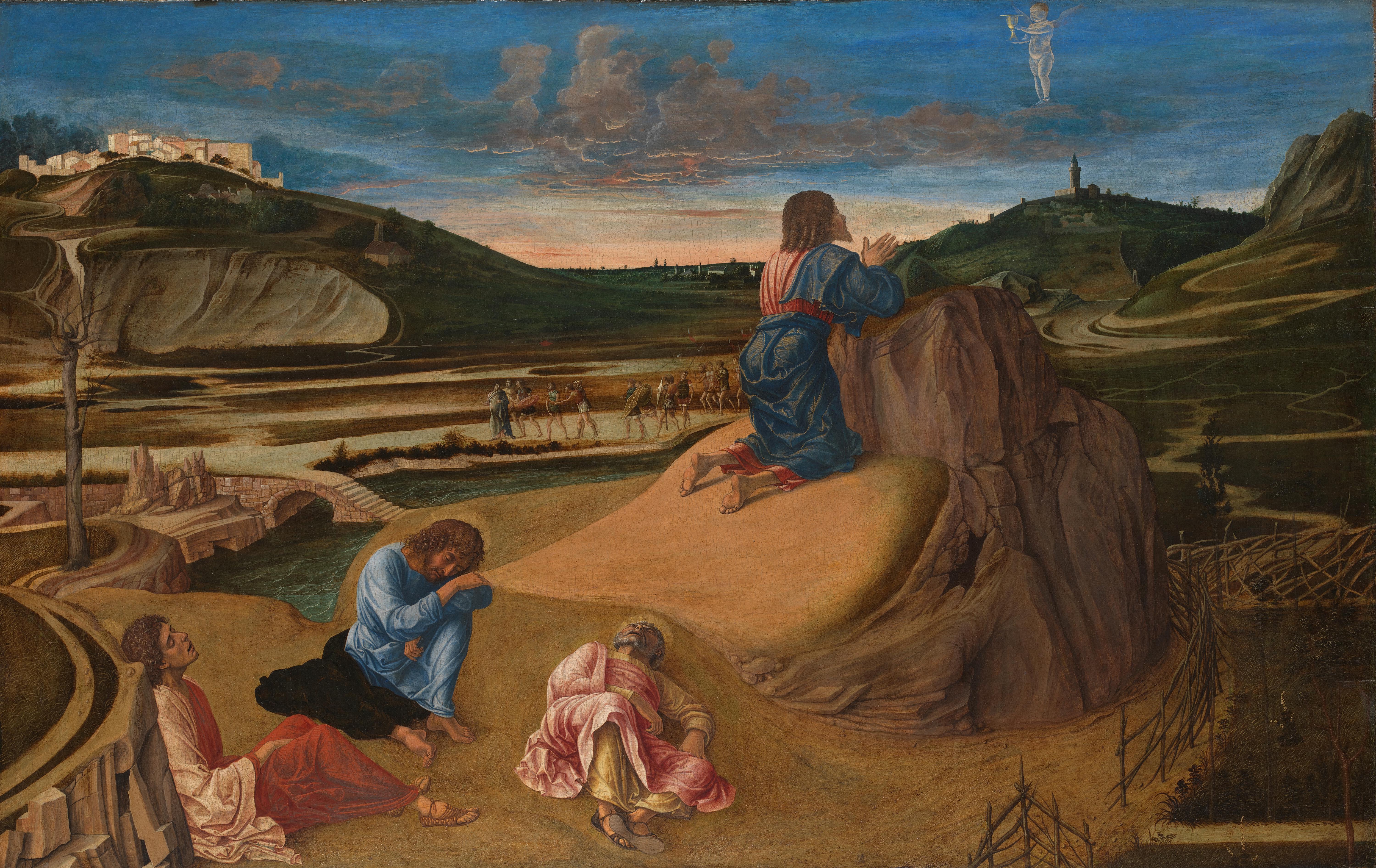
Agony in the Garden by Giovanni Bellini, 1459–1465
 Abiding Quaker