
Now the Lord is that Spirit: and where the Spirit of the Lord is, there is liberty (2 Cor. 3:17 [KJV]).
This morning, as I walked along a street that runs east to west in my neighborhood, I noticed that the overcast sky, which had blanketed our area for the past few days, had finally dispersed, and blue sky was showing between well-defined cloud islands. Along the western horizon, however, the sky was a perfectly clear azure that stood in calm contrast to the cloud movement overhead. I thought that a pilot flying his plane westward into that luminosity might feel the exhilaration of unobstructed freedom to pursue his destination.
Freedom is a deep-seated value for us humans, one that arises from a universal, intrinsic desire. Whether subject to cultural, political, economic, biological, or technological systems, we humans chafe at circumstances that restrict our freedom, and we strive to move past those restrictions. We love freedom, for it is the ability to recognize what is in our heart, and through speech or action—through the mouth or through the hands—to convey it into the world. Freedom allows us to bring forth that which is within into outward expression: it is a confluence of the inward and the outward.
What enables a person to freely express himself is power. Whether the pilot, enabled by his navigation and mechanical skills, heads into the blue or the toddler, beginning to command language, can direct his parents to pour his juice, freedom presupposes power to make the inward will an outward accomplished fact, and therefore as we love freedom, we also love power.
We are taught to use our power well. In the parable of the talents (Matt. 25: 14–30 [KJV]), Jesus tells of a man who before leaving for a journey gives his servants varying amounts of money, which is a form of power. When he returns from the journey, he calls his servants to account and praises those who have made good use of their portion and likewise chastises the servant who has failed to use the particular amount he had been given. The talents in this parable can be applied to natural gifts—such as intelligence or creativity—as tempered by the circumstances that surround one: family, health, and all the many systems listed above (cultural, political, economic, etc.) that influence the exercise of our freedom through offering us both opportunities and restrictions. Jesus teaches that the “lord” in the parable provides a degree of power to each, and that it is essential that each servant make the most of whatever enabling gifts in whatever circumstances he has been given. That is to say, the lesson in this parable is that regardless of the amount is given, the servant is to make the best use of his master’s property, and that lesson extends to us to make the best use of our natural gifts. There is a right use of natural power, and Jesus teaches us to employ it.
But there are limits to natural power, as any servant’s lot, toddler’s tantrum, or pilot’s fatigue will tell you. Even faithful exercise of our natural ability will not rescind the natural limits placed on every life. Eventually, we all bump into one obstacle or another that we cannot overcome, and, in time, we each face mortality. Limitation of power, and thus freedom, is a decisive factor in our human condition, and the way we face our limitation bears upon our spiritual life, our soul.
Driven by the love of freedom but sensing a limitation of power, a person may pursue it in a perverted way; that is, he may lust for power over something or someone. I recently saw a seven-year-old neighbor child stomp repeatedly on a toy dog, only to look up and announce, “That felt good!” One may act to increase one’s power by exercising destructive force, thereby recovering a sense of efficacy, or by reducing the power of others to act freely, thereby assuming a sense of mastery. We all know that it is not only children who exhibit a perverted use of power, for it is a common reaction to feeling inept. Who, in a moment of utter frustration, hasn’t thrown an object across a room?
How is it that beings such as ourselves, created with such a hunger for the joy of freedom should be so thwarted? Scripture and early Friends answer that the exercise of self-will is not the true expression of freedom for which we have been made. Genuine freedom likewise arises from power but not from the power of self. When Christ’s presence is known within, we feel the power of God to express that which is in the heart outwardly into the world: that is true freedom. This freedom is similar to what we have known on our own, but as it is God’s power, and His nature and will are perfect, there is this difference: it works! Freedom is known in its purest form, as it was intended by God for us: to bring His inward nature and will into the heart and from there into the world: the confluence of the inward and the outward remains, but the power, nature, and will are different.
For George Fox, the “gospel”[1] is the power of God, as Paul states in Romans 1:16, and its salient characteristic is its opposition to and victory over the impure, corrupt human rendition of power and freedom. In the excerpt that follows, he ties in the more conventional meaning of the word—“glad tidings” or good news—to this claim: “The gospel is the power of God which turns against that which bondageth, to wit, the corruptions, and so gives liberty and freedom to the captives; and this, which is the power of God, is glad tidings . . . that which gives liberty and freedom to all, is glad tidings.”[2]
Our deep longing for freedom begins to be realized when we can say unabashedly with Jesus, “not my will, but thine, be done” (Luke 22:42b [KJV]). When that position becomes our own, the source, nature, and purpose of power have shifted, and gospel power awaits to provide us with the true liberty and freedom that it alone can afford.
But let us recall our earthly condition, where with the apostle Paul, we quickly admit that this treasure is held in “earthen vessels, that the excellency of the power may be of God, and not of us” (2 Cor. 4:7 [KJV]). Paul lists the aggression that he, in his earthen vessel, has met with during his ministry travels,[3] and he counterpoints each injury with the superior force that sustains him: “the life of Jesus”; Paul tells us later in this book that Jesus’s life is “by the power of God” (2 Cor. 13:4 [KJV]). In this verse, he also extends to us the same principle that operated in Christ’s life—human weakness is supplanted by God’s power: “For though he was crucified through weakness, yet he liveth by the power of God. For we also are weak in him, but we shall live with him by the power of God toward you.”
Our natural love of freedom will spur us on to the use of the natural power that we each have been given and enjoy. Sooner or later, we find that power insufficient when we come across life’s inevitable obstacles and challenges, and we will be tempted to misuse our power: to hide our weakness and project the appearance of efficacy (both in the social sphere and in our own estimation of ourselves), a deceit that disturbs and corrupts the soul that would rest in truth, not lies.
Entering into the truth by acknowledging our limited natural power, our weakness, we will find the grace that is sufficient, the “strength made perfect in weakness” (2 Cor. 12:9[KJV]). When given that power of God, we will have the strength to bring forward—through the mouth or through the hands—into the world the Spirit from which it comes: “I believed therefore have I spoken,”[4] is a verse that testifies to the genuine confluence of inward power and outward expression, the mark of true freedom for which we were created.
We having the same spirit of faith, according as it is written, I believed, and therefore have I spoken; we also believe, and therefore speak: Knowing that he which raised up the Lord Jesus shall raise up us also by Jesus, and shall present us with you (2 Cor. 4:13–14).
[1] “They reasoned that the gospel was the four books. . . . But I told them the gospel was the power of God, which was preached before Matthew, Mark, Luke, and John . . . were written” (Nickalls, 445).
[2] Fox, Works, 3:442.
[3] We are troubled on every side, yet not distressed; we are perplexed, but not in despair; Persecuted, but not forsaken; cast down, but not destroyed; Always bearing about in the body the dying of the Lord Jesus, that the life also of Jesus might be made manifest in our body. For we which live are alway delivered unto death for Jesus’ sake, that the life also of Jesus might be made manifest in our mortal flesh (2 Cor. 4: 8–11 [KJV]).
[4] Psalm 116:10
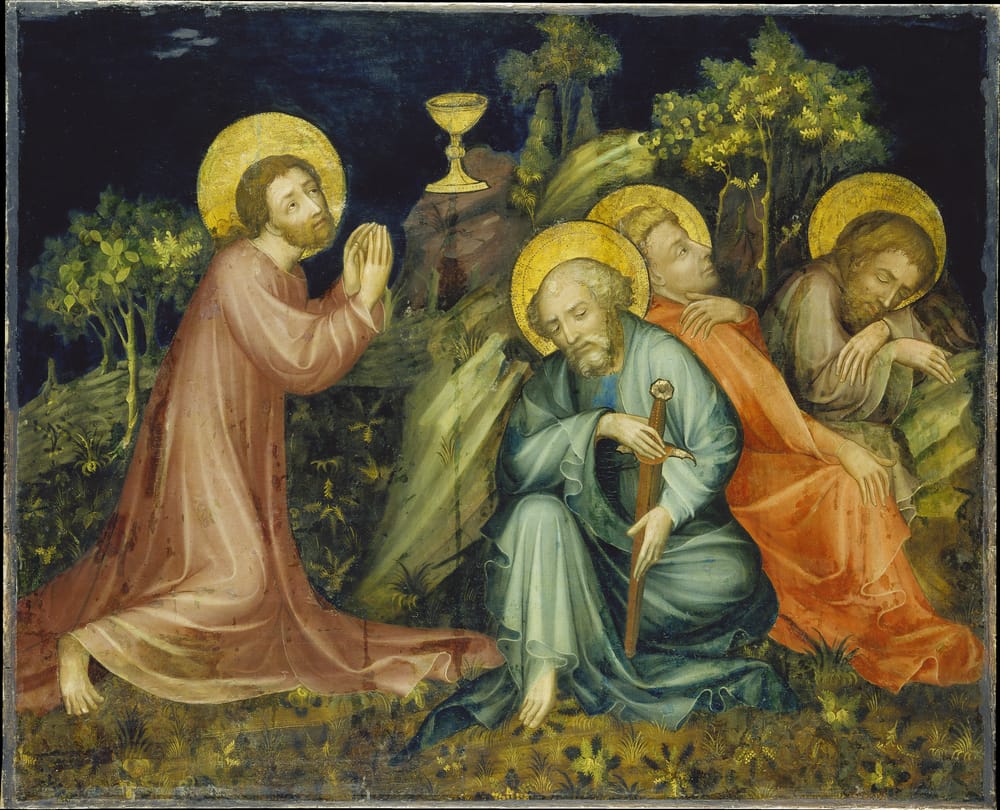
The Agony in the Garden (1420-1430), Nuremberg Master of the Altarpiece of the Virgin

