The Isaac Penington Study Group (IPSG) began meeting last fall to examine and discuss the tract “Some of the Mysteries of God’s Kingdom Glanced At.”1 Over the summer, our group reduced the frequency of our meetings to once a month. In the last session on Eighth month, the 21st, just a few of us showed up for the Zoom meeting where we read and discussed Penington’s description of the nature and cause of joy.2 It turned out to be an especially appropriate topic for our small group of three, as our exchanges during the evening were heart-felt and gracious, thus making for joyful conversation, with Penington having first set the tone with his exuberant telling of the love given by and received from God.
Beginning with recognition of Penington’s references to Scripture (Psalm 42 and Luke 1:47-48) in this passage, we soon focused our discussion on his extended use of the metaphor of earthly love to describe and illustrate heavenly love, which is bestowed by God upon the soul, as can be seen in this excerpt from the passage:
I, who long have been desolate and forsaken, have now found favor in the eyes of my beloved, and my heart feeleth (in measure) that I am his, and he mine, who hath touched me, won my heart, undertaken for me, and what can separate?
Midway through the hour, our discussion turned to the qualities and benefits of the Church in Christ. Comparisons were set forth between the composition and effects of the Church in its healthy state as opposed to “faith” communities that harbor corruption. Comparisons were also made between the Church whose essence is knowledge and worship of Christ, the Truth, on the one hand, and, on the other, the empty pretence of man-made religion; and further differences were noted between the essential practice of gathered obedience to Christ, and the extraneous, inessential concerns and activities that occupy false religion.
A recording of this session (as well as each of the earlier 21 sessions) can be found on the YouTube channel titled “Isaac Penington Study Group.”
Works of Isaac Penington, Quaker Heritage Press: Farmington, ME 1999, 332–353. ↩︎
I am pleased to announce the publication of my new book, The Light That Is Given: Prophetic Quaker Faith. It is now available for purchase at three web locations (listed and linked in the “About” page of this blog) and can be found in Quaker bookstores in the United States. The book is comprised of essays that have been posted on this blog over the years, as well as some new additions. There will be reviews in Quaker journals: Friends Journal, Quaker Religious Thought, and Western Friend, the first two expected within coming months and the third requiring longer. I am including a description of the book that is taken from the web pages of the publisher and the other two online distributors, as well as the editorial reviews presently featured on all three sites. And finally, I’ve included a picture of the cover whose design by Wipf and Stock pleased me very much, as I’ve always enjoyed seeing sunlight through trees. Not only is it beautiful, but it also suggests to me a metaphor for Christ the Light as seen through the Cross (the “tree” referred to in Acts 5:30; 10:39; and 13:29), which ancient Christians knew to be the tree of life.
* * * * *
Description of the book follows:
Speaking from the traditional Quaker claim of inward knowledge of Christ the Light, the author shows her accord with early Friends’ writings and the Scriptures they affirmed. Promptings arising from daily readings and personal interactions provide the starting point for many of the book’s essays. Other genres, including interviews and dialogues, also present a perspective that largely has been lost to modern-day forms of the faith. Though not allowing authoritative texts to displace the prerogative of Spirit, the author often cites both Scriptures and seventeenth-century Friends to support her themes with their good sense and authority, and thus she demonstrates the unity of the faith from century to century, from millennium to millennium.
Editorial reviews from three prominent Quakers follow:
“In The Light That Is Given, Patricia Dallmann assembles a great cloud of witnesses, ranging from the Old and New Testaments, Quaker tradition, and many other sources–Christian and non-Christian. Dallmann’s short essays arise from various times and occasions in her life, in a manner akin to the long tradition of Quaker spiritual autobiography. This practice grounds her witness in a fresh sense of life in the Light.”–Douglas Gwyn, author of A Sustainable Life: Quaker Faith and Practice in the Renewal of Creation
“In this fascinating and wide-ranging collection of essays, Patricia Dallmann applies a distinctly Quaker approach to exploring matters of biblical, theological, and social concern, allowing the inward Light of Christ to speak in and through her. Using this prophetic method, rooted in the faith and practice of early Friends, she offers a faithful testimony, enabling us to mine a rich seam of insight and illumination.” –Stuart Masters, program coordinator for history and theology, Woodbrooke
“Patricia Dallmann brings a modern prophetic voice to Scripture and ancient Friends’ texts. She carefully examines the language of these stories and brings new life to their teachings, but this is no exercise in mimicry. Dallmann shares her own experiences and shows us how traditional Quaker beliefs have guided her. This is an invaluable resource for those wanting to explore how traditional Friends’ faith and practice can be lived out by spiritual seekers today.” –Martin Kelley, senior editor, Friends Journal
Man as he came from God, and was by especial favor formed in his image, so it pleased God to place in him a principle of his own life to govern him. . . . [Man] must know what of himself is ready to betray him, that he may watch against it, and turn from it; and what in himself is given him of God . . . that he may hearken thereto, and be made happy thereby.—Isaac Penington
For three generations, the women in the Murphy family—daughters, granddaughters, and great-granddaughters—had agreed that Grandma Bessie’s home was as close to earthly paradise as could be asked. Abounding with flower beds; herb and vegetable gardens, for summer bounty and winter storage; a grape arbor; raspberries; and an apple orchard, her home offered with each visit new growth, beauty, and good things to eat. Beatrice Elizabeth Murphy (Grandma Bessie to us) had filled her home and life with a wealth that was uniquely hers, such as the 18-inch in diameter geode that leaned against the step to the entry porch and announced her fascination with rocks and gems, a topic that filled the bookcase just inside the door. The wealth the geode intimated was not the kind recorded in bank statements but was instead the inner wealth of largesse, wisdom, and beauty, and this the geode’s crystalline center aptly symbolized.
It was the abundance of the place that made it a paradise for us all. In the kitchen, the largest room in the house, was a massive wood-burning oven where all the baking had been done for decades. A hand pump stood just outside the back door ready to bring up a cool drink of water from deep in the earth. Alongside the east-facing wall was an outdoor shower enclosed by a screen of morning glories that protected our modesty early each day. A rain barrel stood at one corner of the house, and a privy was a ways down the path past the hollyhocks. Summer mornings, there was sparkling dew on the grass and always the Zen-flute call of a mourning dove that drew forth our stillness and wonder. Throughout our childhood, my sister (three years my junior) and my aunt (two years my senior) had long summer days outside playing endless games of imagination and croquet and taking turns on the tire swing. When twilight came with the glow of lightening bugs and the rise of the moon, there was hide-and-seek until the sky turned dark, the air cool, the stars sharp and clear, and the call was heard to come inside.
Some afternoons, though, when the heat of the Iowa summer became too much for us, we chose the indoors and would entertain ourselves with board games on the living room floor. It is here that I will introduce my great-grandfather T. Edward Murphy, Grandma Bessie’s husband. My memory of him is just one thing: he sat in a rocking chair—not three feet from our game on the floor—and said nothing: not a word to us children, ever. I was but four years old when he died in 1955, but even at four, I realized his total silence was strange, and so privately in the kitchen, I asked my grandmother why he never spoke. Her answer implanted itself in my memory when she said, “He was betrayed by a friend.” I don’t remember her explaining more than that, but I do recall the sorrow I felt as I heard her words and realized that my grandfather had been hurt so deeply by another that he had stopped talking altogether.
I am surprised but very grateful that my grandmother answered my question honestly. I am also surprised and grateful that at an early age I was given the intimation that the condition of one’s soul dramatically affects one’s life and that there was an invisible vulnerability in everyone, even grown-ups.
One sick of the palsy
Like the man “sick of the palsy” in the second chapter of Mark, my grandfather was unable to move forward with his life; he was paralyzed into silence and a rocking chair. With my grandfather, the cause of the debility was attributed directly to another: a betraying friend. While no such direct correlation is made to an offending party in the Mark 2 story, there are subtle indications that the man’s suffering was precipitated by another.
Four of the man’s friends bear him and his bed to Jesus, and they go to great lengths to see that he receives attention: they break up the roof and lower his bed (4). It is the friends’ faith that Jesus sees, and as a result of that faith, he pronounces the debilitated man’s sins forgiven (5). In bringing the friends and their faith into this story (singular for a gospel healing story) and making them the precipitating factor in the healing, the point is made that we humans are social beings: sin in one can spread to sin in another; the betrayal of one can lead to the paralysis or diminishment of life in another. We are being told that fact in this story when we see the social dynamic in reverse: the faith of these four friends leads to the forgiveness of, or absence of, sin in another.
Please note that I did not say that the care and concern of these friends effected the man’s recovery. In this Bible story, it is Jesus’s work to discern—i.e., to judge—faith to be present and sin to be past. And the outward events of the story, as always, parallel the inward event: Jesus Christ appears within to announce faith is present and sin is past and forgiven.
We might ask, however, wasn’t it another’s sin and not the paralytic’s—or my grandfather’s? Why is it the victim is specified as having sin? For that is what Jesus does when he says: “Son, thy sins be forgiven thee” (5). In this world, there is and will be endless provocation and victimization,1 but it is we ourselves who allow the sinful behavior of others to diminish our own souls. In allowing that, we take on sin ourselves, for the soul’s death or diminishment is an affront to God from whom our souls are descended and by whom they are to be sustained. I say this not to shame victims but to outline the process by which we become entangled in life-diminishing social stumblings and to strengthen the soul that it not fall into fatal injury but find its way clear to health and wholeness.
The paralyzed man in chapter 2 is a figure for the immobilized condition of the soul suffering the sickness of despair, and the friends who bear the man to Jesus are likewise a figurative allusion to the foursquare honoring of the virtue of life itself when the soul is sick. It is not any particular quality in the paralytic’s life that the friends honor, for no such quality is mentioned, and the man is completely inactive and silent. Rather the friends honor and respect the man’s life for itself alone, devoid as it is of utility or advantage.
In like manner, a person must retain faith in life itself when his soul is under such extreme duress that he finds no ability to function or move forward in life. At this low, seemingly forsaken state, when there appears no way forward and no incentive in the world to carry on, it is too often the case that faith in the virtue of life is set aside, and the self yields to the demonic. That is to say, faith in life is replaced by faith in death: honoring truth and life is replaced by succumbing to death and deceit.
In refusing the demonic entry to occupy and sinfully energize or “enliven” the soul, however, the lifeless, depleted self nobly endures without expectation or hope. Enduring unto the end is the faith required and seen by God in his Son on the cross; it is likewise required and seen by God in us as we undergo the inward cross. It is that faith—called in Quaker tradition “dying to the self”—that allows the Son of God, the Son of man, to say to us, his new brethren, “Son, thy sins be forgiven thee” (5). Risen and again moving forward, newly restored and resurrected to life from death-like despair, we are thus empowered to go our way to our true home as sons of God: “Arise, and take up thy bed, and go thy way into thine house” (11).
The skillful Physician2
It is appropriate that this presentation of Christ’s healing of the soul should open the second chapter of Mark’s Gospel. We learned in the first chapter that Jesus heals both the possessed and the diseased (1:32), and immediately following in this second chapter, we’ve been given more detailed information on the particulars of the diseased soul and the steps needed for its restoration to health.
Just as the scribes assert their shallow apprehension of religion in the segment following Jesus’s healing pronouncement, there will be those today who cling to their idea that this story should be taken at face value as the healing of a physical ailment. Jesus, according to this perspective, is one who differs from us and wields magical, divine, healing power bestowed by God upon him alone (just as the scribes attributed the power to forgive sins to God alone [7]). Both of these faulty interpretations mistakenly presume to revere God and Jesus but instead exhibit a failure to know and understand the inward movement toward salvation that God has ordained and Jesus taught and exemplified. This false faith rests upon doctrines that have been taught, learned, and taught again, as surely was the “faith” of the scribes: “Why doth this man thus speak blasphemies? Who can forgive sins but God only?” (7)
Life Itself
My family offered beauty, opportunity, and strong values to us children growing up, but it offered little guidance on the true path of salvation. There was no mention of my great-grandfather Murphy after he was gone—at least that I ever heard—and I assume the reason was the adults had an unspoken understanding that life had pitfalls and tragedies that were best kept hidden, ignored, and forgotten. Getting on and moving forward with life was the goal, as well as the means.
Perhaps there will be more of us in the future who, while recognizing the goodness of a plentiful life, will yet hold to the belief in the virtue of life itself when despondency arrives to strip away our capacity to move forward. We will let faith in life itself carry us for a time, which, like the four friends in the story, will go to great lengths to bring us into the presence of Christ Within. It is there in Christ’s presence that we will come to know his healing, and to have bestowed upon us—at last—the gift of Life Itself.
Beloved, think it not strange concerning the fiery trial which is to try you, as though some strange thing happened unto you: But rejoice, inasmuch as ye are partakers of Christ’s sufferings; that, when his glory shall be revealed, ye may be glad also with exceeding joy (1 Peter 4:12-13).
Epigraph. Penington, Works, 3:190. “Then said he unto the disciples, It is impossible but that offences will come: but woe unto him, through whom they come!” (Luke 17:1) The King James Version was used throughout this essay.
“Christ is the skillful Physician; he cures the disease, by removing the cause” (Penington, Works, 1:128).
When we read the parables of the Good Samaritan or the Prodigal Son, our first question is not, did this really happen? Rather we ask, is this true? Or even better, we ask, in what way is this true for me? Does this correspond to my own experience? [George] Fox seemed to read not just the parables but the entire Bible as a parable, constantly asking how it applied to his own condition.1 –Tom Gates
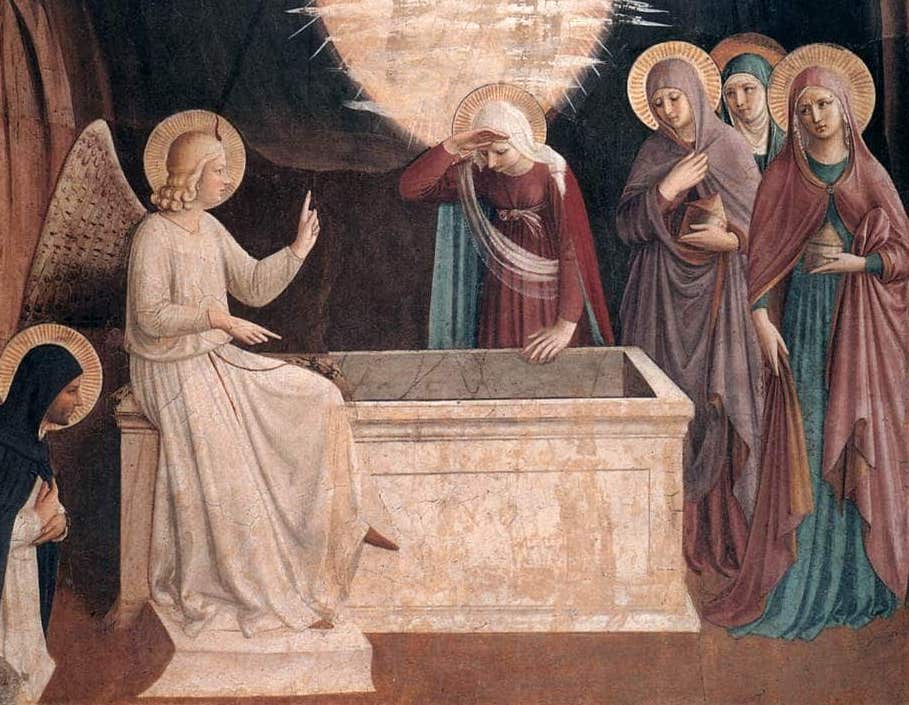
No consideration of Mark’s Gospel is complete without an attempt to explain the seeming rupture between the first and second halves of its last chapter. The first eight verses of the chapter follow the women to the tomb, and from there, we see them leave, amazed and afraid. Though instructed to “tell his [Jesus’s] disciples and Peter” that he will show himself to them in Galilee (7), the women said nothing to anyone (8). The second half of the chapter then begins afresh with a completely different narrative. Jesus is present, active, and appearing to Mary Magdalene: the same Mary who visited the tomb with two other women in the first half of the chapter, in which none of them saw or received instruction from Jesus. The explicit ending of the first half in which the women are silent about their experience is contradicted in the second half, where Mary Magdalene “went and told [the disciples] that [she] had been with [Jesus] . . . that he was alive, and had been seen of her” (10–11).
This disjointed post-crucifixion narrative can be most usefully examined, I believe, in the way that George Fox and other early Friends would have examined it: the way described by Friend Tom Gates in the epigraph. A careful look at the text brings to mind the inward experience that reconciles the discordant halves into coherent spiritual knowledge and teaching. One realizes the writer’s intent could not have been better accomplished by a conventional realistic narrative, and one finishes the reading amazed and full of gratitude.
Part One: verses 1–8
The first two verses of part one set forth its theme: the old is past and the new is begun. The first verse tells of custom and tradition, the old guides of the past: “And when the sabbath was past, Mary Magdalene, and Mary the mother of James, and Salome, had bought sweet spices, that they might come and anoint him.” Tradition directs and orders the attending women’s thoughts and actions: they’ve waited until “the sabbath was past,” for in the tradition, all are commanded “to keep the sabbath”;2 they’ve brought spices to anoint the body, for it is the custom to honor and care for the dead.3
In contrast with the first verse’s focus on the old, verse 2 refers solely to the new: “And very early in the morning the first day of the week, they came unto the sepulchre at the rising of the sun.” It is a new day (“very early in the morning”); it is a new week (“the first day of the week”). They arrive at the tomb “at the rising of the sun” (2).
Carrying the theme of old and new into the next two verses, we learn that the women have come with their customary expectations and reasoning: a great stone will be blocking the entry to the tomb; they haven’t enough strength to move it themselves; they’ll need to find help from others (3). Expectation and reasoning block their way, like a great stone; they operate by the old human way of assessing, calculating, and petitioning. In the new way of things, however, their old nature with its reliance on tradition, reason, and assumption is transcended: the stone is removed, and the entranceway is clear.
The young man
And they all forsook him, and fled. And there followed him a certain young man, having a linen cloth cast about his naked body; and the young men laid hold on him: And he left the linen cloth, and fled from them naked (14:50–52).
And entering into the sepulchre, they saw a young man sitting on the right side, clothed in a long white garment (16:5b).
The mysterious character of the young man functions as the spirit or angel in each of these two very different situations found in chapters 14 and 16 respectively.4 The old worldly way is evident in the young man’s first appearance at Jesus’s arrest. At that time, Jesus was abandoned by all and overcome by violent, worldly force. The spirit of the event was fear and disorder, and so the young man fled, naked and vulnerable. In his later appearance in the tomb, the young man is no longer naked but “clothed in a long white garment”; he is no longer running away in panic but “sitting on the right side” (5), calmly informing the women of Jesus’s resurrection. The spirit of the new situation is now “right,” and the young man speaks as only an angel or benevolent supernatural messenger could: he tells the women Jesus is risen, instructs them of his whereabouts, and where the disciples are to find him in Galilee; he even knows that Jesus has already told them as much (7).
The women’s response
Verse 8, the final verse of the first half of Mark’s sixteenth chapter, describes the impact the new has upon the women: they are amazed and fearful, and so they tell no one of their encounter. It is the women’s reaction that evokes a recollection of my own inward experience and, in part, allows me to interpret this narrative, for my response to my first encounter with the transcendent was as theirs. Amazed at the unanticipated dimension of existence, I was nevertheless convinced of its truth, as the epiphany was irrefutable. Like the women in this story, I felt constrained to tell no one of it; nor did I, for more than a year: my old suppositions and reasoning were so utterly upended by my new experience that I needed time to integrate all parts of my life into a new understanding that was coherent; responsive to God; and dwelt, at last, in peace. It took time for the radical metaphysical shift to settle in my mind and heart, and I was prevented from revealing my inward state until I felt sufficient stability to withstand whatever the world in its confusion and contrariness would cast in my direction, for I knew its nature as a refugee knows her escaped country.
Part Two: verses 9–20
Reciprocality
As the first half of this chapter was about taking in the new reality of resurrection, the second half is about giving out one’s testimony to that resurrection; that is, it is about the telling and presenting to others the new reality that has formed within oneself. The coherence in chapter 16 is provided through the dynamic of reciprocality: the “taking in” and the “giving out” of the gospel, for the text is arranged to teach the reader this first axiom of the new and living way. Once the gospel is received (the first half), it must be ministered to the world (the second half). It cannot be stated too strongly that it is inappropriate to attempt to force a literal interpretation or scholarly explanation upon the seeming vagaries of this text.5
The second half of the chapter begins by referring to the power himself: “Now when Jesus was risen early the first day of the week,6 he appeared first to Mary Magdalene” (9). Unlike Mary’s response in the first half of the chapter, in the second half, she “went and told them that had been with him” (10). For from verse 9 on, the focus is no longer upon taking in the new but upon giving or revealing it to others. Mary appears in both the first and second halves, not to show continuity in the plot (in fact, her appearance shows the discontinuity!) but to stand as an example or prototype of the individual who first receives and then transmits the gospel to others. That it is a woman who is the first to minister the gospel underscores the need—first of all—for inward receptivity.7 In that she tells the men who are in a weakened state of mourning and weeping for what has passed (10), she carries the message of the power of God that heals the broken-hearted; resurrects to life; and imbues and fills with power, even “the weaker vessel,” as the most prominent disciple among them has designated her sex to be (1 Pet. 3:7).
Lesson on receptivity 11–14
Are all as receptive to the gospel as Mary Magdalene was in the second half of this chapter? Verses 11 through 14 answer this question and thus prepare ministers who routinely will encounter lack of receptivity in those to whom they witness. “And they, when they had heard that he was alive, and had been seen of her, believed not” (11). The lesson ministers are to learn prior to beginning their work is that there will be a lack of receptivity on the part of those who hear their witness. No minister should see this as a personal failure, for lack of receptivity typically occurs whenever the gospel is preached, a fact conveyed in this passage by the repetition of yet another example of unbelief (12). Jesus appears to two disciples, who, like Mary, tell the others of their encounter, and again the remainder of the disciples are unreceptive: “neither believed they them” (13). Only after Jesus appears directly to the eleven is there an intimation the remaining disciples have believed; that is to say, there’s no further mention of their “unbelief.” What in this passage is certain, however, is that the responsibility for unbelief is squarely placed on the hearers and not upon the ministers of the gospel. The minister must learn that most will not receive the testimony of “them which had seen him after he was risen” (within themselves), and they must continue their work undeterred by that reaction. Jesus assigns responsibility for this lack when he pronounces judgement and upbraids the unreceptive for “hardness of heart” (14).
Commission and signs (15–18)
Having been warned of the lack of receptivity that awaits them, the disciples/ministers are then commissioned to go out to “preach the gospel”: to give out the Word, everywhere, far and wide (15). Once again, they are reminded of this essential fact: a lack of acceptance faults the hearer, not the speaker: “He that believeth and is baptized shall be saved; but he that believeth not shall be damned” (16). The stakes are high: it is the salvation of the world through the transformation—the convincement/conviction—of each person in it.
Verses 17 and 18 list signs that indicate belief has occurred: that is to say, that the ministered gospel, the knowledge of God, has been received and taken in. Those who have taken in, that is, been transformed by the inward knowledge of God will be given power that is indicated by certain signs. In Christ’s power, “name,” they shall “cast out devils,” i.e., rid their own and others’ souls of foundational, existential error (17). They will know and “speak with new tongues,” i.e., they will be given to speak/minister the Word of God, who is Christ (17). They shall be able to withstand worldly, demonic (serpent-like) assault without incurring harm to their souls, even though, unwittingly, they have taken in the venom, as though having drunk “a deadly thing” (18). And at their hand, the spiritually sick and debilitated will be restored to life (18). An attempt to literally interpret verses 17 and 18 indicates belief has not yet occurred.
Reciprocality in heaven
The final two verses of this chapter complete the theme of reciprocality: the taking in and the giving forth the gospel. After the Lord had instructed the disciples of the particulars of their mission (15–18), he is “received up into heaven, and sat on the right hand of God.” Just as earlier, the young man also sat “on the right side” (5) and gave the women information about Jesus, Jesus as Lord now sits at God’s “right hand” and gives forth his Substance, the gospel power. To whom is he giving his Light and Word? With whom does he work throughout time from within eternity? The final verse of Mark’s Gospel answers our questions and sends us forth:
And they went forth, and preached every where, the Lord working with them, and confirming the word with signs following. Amen.
1. Epigraph: “George Fox and the Bible: A Dual Legacy,” Tom Gates. Friends Journal, June/July ’24.
2. “. . . therefore the Lord thy God commanded thee to keep the sabbath day” (Deut. 5:15b).
3. K’vod-hameit is a term meaning “[l]iterally, ‘respect/honor for the dead.’ In Jewish tradition, preparing a body and holding a prompt funeral are important ways to honor the deceased.” ReformJudaism.org https://reformjudaism.org/glossary/kvod-hameit
4. Similar to the spirits or angels that personify the corporate character of each of the seven churches that Christ addresses in the book of Revelation, the young man represents the character or nature of each of the two situations in which he appears, showing the great contrast between the old and the new.
5. Verses 9–20 are present in 99 percent of manuscripts, yet two codices from the fourth century end with verse 8 (Sinaiticus and Vaticanus). Earlier in the late second century, Irenaeus had quoted Mark 16:19 in Against Heresies, indicating the passage’s composition preceded its omission.
6. Again, we see the newness conveyed by the words “early the first day of the week.”
7. That Jesus “cast seven devils” from Mary Magdalene is interpreted to mean (1) that spiritual restoration is required to minister the gospel, and (2) that the severity of the initial inward state matters not; everyone can be restored. In fact, it is only those who are aware of the need to be healed who are prepared to be healed, as Jesus ironically tells the scribes and Pharisees earlier: “They that are whole have no need of the physician, but they that are sick: I came not to call the righteous, but sinners to repentance” (Mark 2:17).
The Three Marys at the Tomb (detail), Fra Angelico, 1439–1443, Florence, Italy
None but Christ, none but Christ, saith my soul, from the sense of my continual need of him, and from the deep love of my heart unto him. –Isaac Penington
Last autumn, Madeleine Vaché and I began inviting some Friends to a discussion group on the writing of early Friend Isaac Penington. “Some of the Mysteries of God’s Kingdom Glanced At” is the tract that we chose to study. It can be found in volume 2, page 332, of the four-volume set published by Quaker Heritage Press (QHP), titled The Works of Isaac Penington. It can also be found online at QHP’s website here. This tract uses a question-and-answer format to examine the meaning of words that we most frequently use when speaking of matters of faith: Christ, repentance, faith, hope, love, obedience, peace, joy, liberty, prayer, justification, and sanctification are some of the many topics that Penington delves into in this tract.
It is the preface to the writing, though, that provides the context for this study. It is there that Penington distinguishes between the “two-fold way of knowing Christ”: the “literal” and the “spiritual.” The literal, he writes, “is according to a description of him received into the understanding; the other [the spiritual] is according to the revelation or unveiling of him in the heart,” which, Penington goes on to say, entails “spiritual submission and obedience of the gospel.” Though not entirely dismissing the literal way, Penington (Quaker that he is) firmly asserts “the main thing now to be minded is the heavenly birth, with God’s dispensation of life to it, and its separation from the earthly birth, and its way of feeding on the heavenly things.” To that end, Penington’s descriptive answers throughout this writing convey his inward, experiential (“spiritual”) knowledge of whatever topic is in question.
Our discussion group meets every other Wednesday evening for an hour, and attendance has settled into six or seven regulars. We read each question and answer out loud, and then we offer our thoughts and experience in response. We move slowly: both through the reading material and in our discussions. Perhaps some may attribute the ponderous pace to the fact that most of us are “of retirement age,” but it is, I believe, our accessing deep, personal understanding that has taken decades to form that sets and regulates that pace, inhibiting the talk that trots “trippingly on the tongue.”
As a result, I have taken the liberty of reducing some of the longer stretches of silence before making discussions public on our YouTube channel, Isaac Penington Study Group(here linked). There you can find the sixteen discussions that we have had since beginning in November, moving through questions, such as “What is Christ”? “What hinders union with Christ”? “How is faith received”? We are now considering Penington’s words on “hope,” which can be seen in the fifteenth and sixteenth sessions. Please feel welcome to leave a comment below any session’s recording.
The image that I’ve chosen for both the YouTube channel and this post is Rembrandt’s The Apostle Paul in Prison, painted in 1627. I find this painting appropriate for a channel featuring a study of Penington, because he spent time in prison where he thought and wrote, as Paul is shown to be doing in this painting. Each of these men’s lives were devoted to witnessing to the great inward illumination Christ had provided them, and Rembrandt, too, must be included among them, for his work also tells of the Light that is given.
[Here is a short essay from the last time North America witnessed a total solar eclipse: August 2017.]
This past Monday, the 21st, was the day of the solar eclipse, and verses from Mark came to mind:
But in those days, after that distress, the sun will be darkened, the moon will not give her light; the stars will come falling from the sky, the celestial powers will be shaken. Then they will see the Son of Man coming in the clouds with great power and glory, and he will send out the angels and gather his chosen from the four winds, from the farthest bounds of earth to the farthest bounds of heaven (13: 24-27).
The words are from Jesus to his disciples. Prompted by their admiration of impressive temple (and temporal) buildings, Jesus informs them that “Not one stone will be left upon another; all will be thrown down” (2). The theme throughout this discourse in Mark 13 is great destruction precedes the coming of the Lord, and Jesus drives the idea home with metaphor after metaphor.
Of course, as always, Jesus is talking about the inward condition/nature of human beings, not about the outward condition of nature.
What is it that must be eclipsed within? What inward light of nature must be witnessed as dark futility, as death, before the new creation, the Son of Man, comes and replaces that old creation of human nature?
I had seen birth and death, But had thought they were different; this Birth was Hard and bitter agony for us, like Death, our death.
==from “Journey of the Magi” by T.S. Eliot
The truth of our limitations is “hard and bitter agony for us” mortals, but choosing it over self-delusion leads to eternal life. It is the way, and when allowed daily to prevail, it will diminish us until the light of our nature—our hope and trust in our natural powers—is all but gone: “the celestial powers . . . shaken.” It is not the end, but only the end of the alienated condition: our nature eclipsed by the coming of the Son of Man. “And what I say unto you, I say unto all. Watch” (37).
Watch the light of nature undergo the eclipse . . . within.
The image is Albrecht Durer’s Adoration of the Lamb, created in 1498.
The beginning of the gospel of Jesus Christ, the Son of God (Mk. 1:1 KJV).
Humanity carries gifts given to no other creature, yet we have not been given power to justify our existence. The gospel, which is the power of God,1 supplies this necessity, so that we may give over faulty, fallen attempts to self-justify, and at last rest assured in the faith that makes us whole. In this gospel, we feel complete: Truth’s perfection is known; our ancient yearning is met and satisfied. In the first chapter of Mark, whose topic is “the beginning of the gospel of Jesus Christ,” the way is introduced.
As in much of Scripture, the text here brings types and figures of spiritual conditions and processes into view, so we can more easily recognize and name inward truths that otherwise might remain hidden and obscure. The text does provide historical and geographical information, but such objective facts lack spiritual significance if not related to inward realities. The Bible and early Friends writings are texts about humanity’s spiritual malaise and its return to vigor; to view these spiritual resources primarily as fields in which scholars harvest ideas to increase our store of knowledge is to disregard the value and purpose of the writings. Since the 1990s, spiritual exposition of biblical or Friends writings has been largely co-opted by academic reductionism that has kept pace with our society’s veering toward the materialism of technology. Should Friends return to gospel order, the present time in hindsight likely will be seen as a period in which scholarly pursuit stood in place of prophetic faith, and information pinch hit for wisdom. Friends knew “that being bred at Oxford and Cambridge was not enough to fit and qualify men to be ministers of Christ.”2 Yet in their time and in ours, the loss of the gospel allows scholars to step into the void. Early Friends were adept at drawing parallels between the events and persons in Scripture and inward, spiritual life, because they themselves had traveled the complete path to salvation. That inward journey opened Scripture’s imagery for them, and using that imagery, they were enabled to record and communicate their experiential discovery of Christ Within, a discovery they knew to have universal significance, beyond information that is intellectually gathered, dispersed, and received.
In the following paragraph, early Friend Margaret Fell provides an example of writing that offers spiritual wisdom about the human condition. She correlates the messenger-prophets referred to in the first chapter of Mark—those who prepare the way of the Lord—to the “measure of the Substance” present within each person.
So a measure of the Substance, and of the life of all the types and figures, thou hast in thee, if thou be faithful and obedient when it checks and calls thee to repentance. For the baptism of repentance, which washeth away the filth of the flesh, thou art not yet come to: no, nor the first principle that leads to it, which is the messenger that goes before him to prepare the way for him which baptized with the Holy Ghost and with fire.3
As do the outward messenger-prophets in Scripture,4 the inward “measure of the Substance . . . checks and calls [one] to repentance.” All must first come to this measure of the Substance in themselves, as all in Judea and Jerusalem outwardly came to John, “confessing their sins” (5). Fell states this is the “first principle that leads to being “baptize[d] with the Holy Ghost,” a work to be done by Jesus, says John (8): a work to be done inwardly by Christ, the Light.
Baptism indicates a new state has been entered, and John’s baptism of Jesus signals his divine acceptance: “Thou art my beloved Son, in whom I am well pleased” (11). Inwardly, baptism with the Holy Ghost reveals this divine relationship. And entering into it, one “immediately” finds oneself driven by that same Spirit (12) into a solitude where there is longtime temptation (13) to become one among the many “wild beasts”5 (12). The badgering, hounding ploys of Satan, however, cannot degrade those who attend to the support heaven offers (13).
The beginning of Jesus’s ministry (15-20)
Jesus’s ministry begins with his announcement describing the spiritual situation: “[t]he time is fulfilled, and the kingdom of God is at hand,” and it continues with instruction to his hearers to find their place within this new situation: “repent ye, and believe the gospel” (15).
His next step is to gather disciples, two sets of two brothers: Simon and Andrew, then James and John. Calling two simultaneously is a narrative devise to signify Jesus has the stature to lead. If only one disciple were called at a time, the reader’s attention would be diverted from Jesus to that disciple. (What was it about that particular man that made Jesus call him?) The intent here, however, is to present Jesus as the adept, rightful leader. That a second pair of brothers (James and John) is called immediately after the first pair (Simon and Andrew) simply underscores Jesus’s position as leader. “Come ye after me” is his call (17).
The nature of his work (21-39)
Both beginning and ending verses of this passage provide the same information: “[Jesus] entered into the synagogue, and taught” (21), and “he preached in their synagogues” (39). Teaching and preaching is his work (38), and he does so with authority (22), because he has the gospel, the power of God, to direct his speech. In the intervening verses (23-34), however, he does other work: he heals “them that were diseased, and them that were possessed with devils” (32). That these healings are sandwiched between the beginning and ending statements that describe his work as verbal communication is to say that the Word of God, Christ, heals the soul. The outward healings in this passage figuratively manifest the inward, spiritual healing that the Inward Christ effects.
The first healing is of a man with an unclean spirit (23-26). What distinguishes this man as devil-possessed is his conscious opposition to goodness. “I know thee who thou art, the Holy One of God,” he addresses Jesus. “[A]rt thou come to destroy us?” Fully aware of his own defiance, the demon is determined to continue unchallenged: “Let us alone,” he pleads. His use of plural pronouns, “us” and “we,” throughout indicates the presence of a divided self: he’s aware of the might and right of the holy (“the measure of the Substance”) within his conscience, and he rebels against it.
That Jesus commands the man to be silent (“[h]old thy peace” [25]) shows the first step toward healing is to block false gains afforded by the practice of evil. The demon’s speaking gains him control and power, an idol frequently worshiped by the devil-possessed. Jesus’s command to be silent, prepares the way, makes the path straight (3-4), so the demon can be dismissed (“come out of him” [25]). Having been deprived of power, the demon has no reason to remain. This story is an example of an inward, spiritual process that is described through figurative imagery.
The second type of healing that Jesus does is simpler: it is healing of a disease. Peter’s mother-in-law “lay sick of a fever” (30). A disease differs from devil-possession, in that there is nothing to be gained from being ill: one is simply unable to feel and function well; there is a loss of power, not a false gain. Jesus heals the woman by taking her hand and lifting her up (31). Unlike the devil-possessed man, she doesn’t speak; there is no false assertion of power. Once healed, however, she is empowered to minister (31). There is a self-awareness in the woman; she feels her debilitated state, and thus Jesus can return her to health in a simple manner: by taking her hand, a gesture of comfort, and lifting her up (31), signifying resurrection to life.
At the end of the day, as both “the diseased and them that were possessed with devils” (32) are brought to Jesus, we understand that all humanity is in need of healing and to be found in one of the two groups described: the “diseased” figuratively representing the suffering of those who are dispirited, not knowing the Spirit of Christ; and those “possessed with devils” figuratively representing all who defy their consciences for some illicit gain. Jesus extends healing to both.
The leper (40-45)
In the final passage of the chapter, both Jesus’s work and social position becomes more complex. He is now approached by someone who has heard of his healing power and beseeches him to heal him of leprosy. The leper exhibits the salient traits found in each of the two former healings: like the devil-possessed (23, 26-27), he’s said to be unclean (40-42), and like the humble woman, he shows humility in kneeling before Jesus. The combined features of the two in the one to be healed indicate the onset of the increasing complexity Jesus will be required to handle as his ministry expands.
Further complications become evident when the leper disregards Jesus’s instruction to “say nothing to any man” and to honor the tradition by following its prescriptions (44). Jesus has power to heal, but he does not control the social ramifications of his healing, and this passage foreshadows the conflict with the worldly religious hierarchy that will beset and complicate his mission.
This chapter’s telling of the beginning of the gospel of Jesus Christ began with its prophetic context, revealed its origin to be divine acceptance, and intimated that there are predatory temptations in a spiritually deserted world. Jesus showed himself adept as a leader, a preacher and teacher, and a healer. The chapter details a steady increase of Jesus’s power and scope but concludes on an ambiguous note. His success is described in terms of limitation: he “could no more openly enter into the city, but was without in desert places: and they came to him from every quarter” (45). May we each “from every quarter” go to the inward, “desert places” where Christ and his teaching and healing are found.
“The gospel is the power of God which turns against that which bondageth, to wit, the corruptions, and so gives liberty and freedom to the captives; and this, which is the power of God, is glad tidings . . . that which gives liberty and freedom to all, is glad tidings.” George Fox, The Works of George Fox (Philadelphia: Marcus T. C. Gould, 1831), 3:442.
Works, 1:71.
Margaret Fell, Undaunted Zeal, ed. Elsa F. Glines (Richmond, Ind.: Friends United Press, 1974), 58-59.
Verse 2 echoes Malachi 3:1a: “Behold I will send my messenger, and he shall prepare the way before me: and the Lord, whom ye seek, shall suddenly come to his temple.” Verse 3 echoes Isaiah 40:3: “The voice of him that crieth in the wilderness, Prepare ye the way of the Lord, make straight in the desert a highway for our God.”
“Some men have the nature of swine wallowing in the mire. Some have the nature of dogs, to bite both the sheep and one another. Some have the nature of lions, to tear, devour, and destroy. Some the nature of wolves, to tear and devour the lambs and sheep of Christ: and some the nature of the serpent, (that old adversary,) to sting, envenom and poison. . . . Some men have the natures of other beasts and creatures, minding nothing but earthly and visible things, and feeding without the fear of God. Some have the nature of a horse, to prance and vapour in their strength, and to be swift in doing evil. Some have the nature of tall sturdy oaks, to flourish and spread in wisdom and strength, who are strong in evil, which must perish and come to the fire.” Works, 1:106-7.
Time will say nothing but I told you so, Time only knows the price we have to pay; If I could tell you I would let you know.
If we should weep when clowns put on their show, If we should stumble when musicians play, Time will say nothing but I told you so.
There are no fortunes to be told, although, Because I love you more than I can say, If I could tell you I would let you know.
The winds must come from somewhere when they blow, There must be reasons why the leaves decay; Time will say nothing but I told you so.
Perhaps the roses really want to grow, The vision seriously intends to stay; If I could tell you I would let you know.
Suppose all the lions get up and go, And all the brooks and soldiers run away; Will Time say nothing but I told you so? If I could tell you I would let you know.1
— W. H. Auden
I came across this poem a few days ago, and it reminded me of an incident in my life from decades ago. Since that time, the scene had lain dormant in my memory, never having made sense. The line in the poem that evoked the memory was “If we should weep when clowns put on their show.” This exact situation came about when I was in my early 30s and was assisting at my daughter’s kindergarten on the day a clown performed for the class. It was a special event for the kids, and once my tears began, I felt dread at the thought that the children might notice, and so kept to the back of the room. In front of the performing clown, the five- and six-year-olds sat on the floor, engrossed and completely silent. As I recall, neither did the clown make any sound throughout his performance.
I think it was the silence of both performer and audience that largely affected me. Perhaps the silence signaled to me the children’s keen drive to learn; to take in this and all new information; instinctively, to prepare themselves for life to come. Perhaps it was the performing man’s utter humility in presenting himself as a clown, and his generosity in giving the children some new experience that he was able to offer. Whatever it was, the situation overwhelmed me, and though I tried, I could not hold back my tears.
I checked the Internet just now to see if there was any information on why people weep when seeing a clown perform, and could find nothing. Neither had I seen anything written on this topic in the more than four decades since the incident had occurred, nor had I heard mention of it prior to discovering the line in this Auden poem. So I thought that if I analyzed the poem, I might come to understand what had evoked my strange response from long ago.
One of the refrains—“If I could tell you, I would let you know”—suggested to me a word-encased wisdom that the loving speaker knew could not be taken in or absorbed. The other refrain—“Time will say nothing but I told you so”—said to me that in time, we learn that the old, impenetrable words contained wisdom all along.
Perhaps that was it: the children who were so attentive and so open would come in time to undergo the common, inevitable strain that each must endure, the slow emptying into meaninglessness of all that had been built up within: as Auden called it, “the price we have to pay.” Only then could they come to the humble generosity of the clown before them that day. Then might they find the worthy words, and perhaps, like Auden, give forth the old understanding in yet a new form.
That year, 1982, was the final, intense stage of a depression that had plagued me for nearly two decades. The difficult time would finally end one year later in what our tradition calls “the second birth,” also known as being “born of the Spirit.” In late January in the middle of the night—a cold, dark time—came great peace and astonishment: I was given the answer to the question for which I had had no words.
If I could make it known to the children who are innocent, silent, and eager to learn, if I could tell them, I would let them know. Still, I think there is better wisdom in the difficult way it has been arranged . . . that after the weeping at the tomb, true peace and understanding ascends.
This past month my daughter sent me a podcast in which was recounted the life history of Benjamin Lay, an early abolitionist and Quaker of the 18th century. Lay often acted as would a modern performance artist, engaging in inventive acts for a political cause: he sought to shame slaveholding Quakers into an awareness of their cruelty and hypocrisy. Unsurprisingly, his performances were not well-received, and in 1738, he was disowned by Abington (Pa.) Meeting. Lay retreated from Quaker society to live in a cave not far from the meetinghouse, his abode furnished with a private library of two hundred books. Centuries have passed, and Lay, once deemed a gadfly, is now hailed a hero.
How does the sequence of Lay’s critique of and then retreat from society pertain to chapter 15 of the Gospel of Mark? In both instances, the light of the Word exposed the dark spirit, which, in turn, strove to overcome it by silencing the speaker through banishment or death. With the darkness exposed and his work done, the prophet in each case became silent, leaving the corrupted social body to itself: either to acknowledge the reality the light had revealed, or to refuse to see and to remain in darkness.1
In the several decades following the testimony of Benjamin Lay, the Society of Friends slowly moved toward accepting the reality that slaveholding is sin, and in 1776 (17 years after Lay’s death), Philadelphia Yearly Meeting deemed the owning of slaves to be an offense requiring disownment.
In Mark 15, which tells of Jesus’s crucifixion and death, we find the same pattern that regularly occurs when light has shone forth in darkness: there follows worldly persecution; prophetic silence; and ultimately, the world’s acknowledgment of truth. In this narrative, however, the sequence is greatly compressed in time: the apprehension of truth comes moments after Jesus’s death. First to speak, a centurion, seeing “how [Jesus] died . . . said, ‘Truly this man was a son of God’” (39). That this expression of convincement was uttered by one so greatly averse to the Way (being a supporter of empire as well as an executioner) portends the universal restoration of humanity to its true state of seeing and becoming sons of God.
Contagion (1-32)
Before reaching the centurion’s words, however, the chapter reviews the labyrinth of iniquity through which Jesus, silent and unresisting, is dragged. The first two-thirds of chapter 15 illustrate the spread of corruption and ignorance—up, down, and throughout the social hierarchy. Pilate, a Roman prefect (governor), wields imperial power and therefore is in society’s highest echelon; he is petitioned by the chief priests to treat Jesus as a criminal (1-3). At the other end of the social spectrum are the people, whom the priests stir up to cry out for Jesus’s crucifixion (11, 13-14). So tainted is the society with the dark, demonic spirit that nowhere can be found the pure light of truth, and Jesus is all but silent, knowing that this is the way of things.
His one statement throughout his captivity is in response to Pilate’s question: “Are you the king of the Jews?” Jesus doesn’t answer him directly yes or no (thereby denying the prefect’s power) but instead makes Pilate himself an unwitting exponent of truth when he answers: “The words are yours” (2).
Jesus’s refusal to speak in his own defense during the remainder of his ordeal implies his early statement to Pilate stands applicable to every opposition he encounters. His continuous silence drives home the fact that the violators’ words and actions are their own—their responsibility alone—and not his. He will not take part in, cooperate, nor assert himself (5); neither does he engage them nor accept their tender mercies (23), for to do so would give latitude to yet more self-deception in their already corrupted souls. If Jesus were to take part in the proceedings—even to resist—his participation would allow the persecutors to claim that he had brought upon himself the treatment he receives, and as such, that he should bear the burden for what is, in fact, their sin. Even Pilate can see that the responsibility for this travesty lies upon the chief priests and their malice (10).
This glimmer of insight shown by Pilate does not absolve him of corruption, only of ignorance. His interaction with the mob regarding Barabbas, the prisoner to be released (6-15), recalls the populist politician who can “whip up the crowd into a mob frenzy.”2 In his first receiving Jesus from the chief priests and then delivering him to the soldiers to be flogged and crucified (15), Pilate is the center link in the chain of crime. It is this “division of labor” that allows each party to deceive themselves into thinking they are absolved of responsibility for wrong-doing; thus Jesus’s arrest, trial, persecution, and death illustrates the most spiritually dangerous, destructive configuration of “the prince of this world”: collusion among the wicked.
Darkness over the whole land (33-37)
That Jesus is the “king of the Jews” is a motif woven throughout chapter 15. Early in the chapter in verse 2, Pilate asks Jesus directly: “Are you the king of the Jews?” Later before the crowd, Pilate uses the phrase to rile the mob (9, 12). For the soldiers, it provides opportunity to address Jesus mockingly (18), and as a criminal charge, it is inscribed above Jesus’s body on the cross (26). Finally, in a vile culmination of corruption and ignorance, the chief priests and scribes use the term “king of Israel” to mock Jesus as he dies:
Let the Messiah, the king of Israel, come down now from the cross. If we see that, we shall believe (32).3
This chapter has steadily, increasingly brought the darkness of moral and intellectual error to the fore. That is to say, corruption and ignorance have become acute. So severe does the darkness become that it envelopes the land, though the sun be at its zenith in “the sixth hour” (33). Lasting three hours (three, in Hebrew, being the number of completeness) “until the ninth hour,” we are being told that the darkness is at its greatest intensity. At this point, Jesus’s words come forth: “Eli, Eli, lema sabachthani?” (34) Sensing abandonment, being forsaken by God, is to have lost sight and hope: the darkness is absolute.
That Jesus speaks these despairing words in Aramaic, his native tongue, rather than the Hebrew in which Psalm 22 (from which these words come) was written is interpreted in this way: individual, personal experience of the typology of Scripture is required of everyone. The Cross is personal and inward, as early Friends knew and preached.4
Though the corruption of the priests is no longer on view at this point in the narrative, the darkness of ignorance remains, and verse 36 gives us the chapter’s final expression of spiritual blindness as portrayed by the bystanders who mistake Jesus’s words for a call to Elijah: “Hark, he is calling Elijah. . . . Let us see . . . if Elijah will come to take him down” (35-36). With Jesus’s death (37), even the darkness of ignorance is overcome: following the rending of the temple veil that figuratively separated God and man, the centurion states: “Truly this man was a son of God” (39).
Outspreading (40-47)
First evidenced in the centurion, awareness of and right regard for Jesus grows steadily throughout the remainder of this chapter and into the next. The growth is first seen in numbers, as women—many women—who followed, ministered, or came with Jesus to Jerusalem look on, though they be far off, and thus their vision is but small. Yet watchful from a distance, the women see the Son of man, the master of the house (Mk.13:33-37).
Right regard for Jesus gains ground within the social hierarchy when next appears one who is individuated by name: Joseph of Arimathaea. As an individual and a male, Joseph not only stands in patriarchally favored contrast to the group of women, but more significantly, as an individual who is named, Joseph stands apart from the undifferentiated cackle of corrupt priests. The contrast between them and Joseph is further heightened by the fact that though both the priests and Joseph are peers in the Council (the Sanhedrin, which was the supreme court of the Jews), only Joseph is described as “a respected member of the Council” (43).
As a “respected” member of the highest court, Joseph is distinguished as having good judgment. In the same verse, we learn that he “waitedfor the kingdom of God” (43 KJV). That these two facts occur in the same verse suggests there is a correlation between good judgment and waiting to receive God’s kingdom.
Joseph understands that God and his kingdom must be waited for: that he himself is not a god, and therefore he does not exalt himself by claiming that he need not wait but perpetually inhabits the kingdom. In contrast, the priests (neither differentiated nor esteemed) see themselves “as gods knowing good and evil,” thus claiming for themselves a power of judgement that they do not have. The text implies that one must wait for and receive the virtue and power of God to judge righteously: to be enabled to distinguish good from evil, King from subject, and Christ from self. One must know the difference experientially before one can make a distinction intellectually (1 Cor. 6:2 KJV).
Joseph makes this distinction, and therefore he waits for the kingdom of God, thereby showing the good judgment for which he is respected. To reinforce the idea that Joseph’s waiting is the preparation needed to receive the kingdom, he appears on “Preparation-day (that is, the day before the Sabbath)” (42), which suggests that Joseph judiciously prepares for the Rest to come: he prepares and waits for the kingdom of God (43).
Second, we see that Joseph is not only a man of humility and good judgment but also a man of courage and one who takes responsibility: Joseph “bravely went in to Pilate and asked for the body of Jesus” (43); he, at his own cost, then provides Jesus with a respectful burial (46). Joseph’s actions mirror in reverse those of the priests who delivered Jesus to Pilate (1) and treated him disrespectfully (32).
In verse 44, we see Pilate continue his policy of questioning others (2, 4, 9, 12, and 14) and letting their answers determine his actions: he thus equips himself at every turn with opportunity to deny personal responsibility. (And therein is he contrasted with Joseph.) In this passage, after questioning the centurion (44), Pilate—ever the middleman—releases the body to Joseph: the death effected as much by his lack of moral responsibility as by the priests’ and people’s villainy.
In the next and final chapter of the Gospel of Mark, we will see a continuation and acceleration of the forward momentum toward regard for and knowledge of Jesus as Lord. In this chapter, however, the story ends with the women standing by: women who are named, individuated; waiting; alert and watchful.
And Mary Magdala and Mary the mother of Joseph were watching and saw where he was laid (47).
1. “Here lies the test: the light has come into the world, but men preferred darkness to light because their deeds were evil” (Jn. 3:19). I’ve relied primarily on the New English Bible throughout this essay. When I’ve used the King James Version, I’ve so indicated in the text.
3.The priests’ insistence upon Jesus meeting their skewed criterion of Messiahship is tantamount to their claiming themselves to be the arbiters of good and evil, that is, to “be as gods, knowing good and evil” (Gen. 3:5). This lie is the serpent’s temptation that led to humanity’s fall from grace. It is appropriate that this particular offense (which is echoed in the same verse by the thieves’ taunting) appears in the narrative at the point of greatest darkness, for it was the first sin in Eden and is shown to be the last at Golgotha: suggesting that—first and last—to exalt the limited, natural perspective is the root of all sin, the sin of pride. That the error issues from both the priests and the thieves tells us that whether high-up or low-down, all are guilty who presume to judge—to discern good from evil—while constrained by the fallen nature of the first Adam.
4. That the Cross must be borne by everyone is suggested by the figure of Simon the Cyrenian, an everyman passerby, who was required to carry the cross (21).
It is conceived in sorrow, and brought forth without any to pity it; nor does it murmur at grief and oppression. It never rejoices but through sufferings, for with the world’s joy it is murdered. I found it alone, being forsaken.1 – James Nayler
In chapter 13 of Mark’s Gospel, Jesus used figurative language to describe the suffering each and every soul must endure prior to receiving the Light of Christ Within. In chapter 14, we see Jesus enter into his own particular tribulation, and thus we are provided with the archetype for each of our own journeys through the world. In chapter 13, we were told of the way forward; in chapter 14, we are being shown that way.
Though the circumstances of Jesus’s tribulation will be uniquely his own, the particulars point to the universal formation that every person must undergo, each in his own distinct time and place, each with her own unique history and circumstances. Chapter 14 presents a template of the conflict; error; corruption, both personal and institutional; violence; cruelty; pain; shame; abandonment; and isolation that one suffers in a life that is lived over the decades. For Jesus, however, all the injury happens within a few days. Regardless of the intensity of his ordeal, he steadily assures us – and perhaps himself – throughout the account that this apparent calamity is in accord with God’s will; it is all to be expected, for this is the one and only true way to eternal life.
Trouble without and within (1-11)
In this chapter, there are two groups of characters that bring about Jesus’s suffering and death: the corrupt religious establishment and the uncomprehending disciples. Judas’s betrayal is the act which brings the two groups’ determinants – corruption and ignorance – together and amalgamates them into a force capable of inflicting the suffering Jesus will endure. The opening passage of the chapter, verses 1 through 11, introduces all three of these components: (1) the corruption of the religious establishment, (2) the ignorance of the disciples, and (3) the betrayal of Judas.
The chief priests’ and scribes’ treachery is exposed immediately in the first two verses of the chapter: “After two days was the feast of the passover, and of unleavened bread: and the chief priests and the scribes sought how they might take him by craft, and put him to death” (1).2 While Israel makes plans to celebrate its historic deliverance from captivity and oppression (the exodus from Egypt), its chief priests plot to destroy the one who would have all know deliverance from inward captivity and oppression. These religious leaders should be celebrating and advancing the people’s freedom, but instead they plot their continued captivity, and thus is the institution corrupted.
Next in this introductory passage is a short story (3-9) that reveals the disciples’ failure to understand Jesus. In “the anointing at Bethany,” the disciples criticize a woman who has honored Jesus by anointing him with costly oil; the disciples see the act as wasteful and would have had the money used to serve the poor. Jesus justifies the woman’s having “done what lay in her power” (8), thereby siding with one who acts with personal initiative, understanding, and love for him. The disciples argue that virtue is the function of principle and outward, social action while Jesus teaches virtue is an expression of the heart. Furthermore, Jesus sides with a woman who is jointly criticized by a group of men. His claim that the whole world will honor her act wherever the gospel is proclaimed (9) reverses the power imbalance begun with the disciples’ joint castigation. The disciples find power in the crowd; Jesus finds power in righteousness.3
Finally, completing the introductory passage, are two verses that bring together the corruption of the religious leaders and the ignorance of the disciples: Judas Iscariot is “one of the twelve [and he] went unto the chief priests, to betray [Jesus] unto them” (10). The priests’ and Judas’s complicity is registered in the next verse, and their joint force is now complete and active: “And he sought how he might conveniently betray him” (11).
Just as he had told them (12-31)
Given that the destructive force is now in place and set to act, it is imperative to show that Jesus is aware of all that has passed, is passing, and will come to pass. The narrator must show that Jesus has a higher, truer grasp of reality, beyond mere human capacity. To the human and limited understanding, Jesus will be broken and killed; however, on the true, divine platform of reality, Jesus is supreme; unconquered; and wholly, fully in control.4 These expansive, divine qualities are shown figuratively in his ability to foresee the future.
In the first five verses of this section (12-16), the narrator depicts Jesus as having a more-than-human foresight of the complex sequence of events that will allow him and his disciples to conveniently organize and enjoy the Passover supper. The implication is that if Jesus has such detailed prescience of this minor accommodation, he certainly is able to foresee events of major importance. And during the Passover meal, this implication is borne out when he alerts his disciples that one of them will betray him (18), that he [Jesus] will die (25), that all of the disciples will fail him (27), that he will be resurrected and lead the way into Galilee (28), and that the cock will crow twice and Peter deny him thrice (30).
Not only does Jesus’s envisioning the future designate him as having divine power, but when all that he has forecasted has come to pass, his disciples (and we readers) must conclude that this trial of suffering and death is, in fact, the will of God. That Jesus twice refers to Scriptures as having foretold the course set out for the Son of man (21, 27) again confirms that an amendatory tribulation is in fact God’s will throughout time.5
Acceptance (32-52)
Hitherto in the stories of Mark’s Gospel, Jesus has led and taught his disciples, and he has shown all his opponents to be no match for him in virtue and power. We have seen Jesus in this role of the god-like man, and have rightly attributed his greater-than-human ability to his knowledge of; reliance upon; and unity with God, the Father. In this passage, however, that knowledge of, reliance upon, and unity with “Abba, Father” (36) requires him to forfeit all the preeminence that has been given him in the world, and thus outward manifestations of his commanding strength are largely absent. He is unable to summon his three closest disciples to stay alert while he prays, and he is betrayed by another who’s in league with his long-standing, corrupt opponents. Arrested upon their orders, Jesus is treated as a lowly thief (48).
In this passage, strength of spirit is not exhibited outwardly by directing or defeating others; rather the fleshly will is directed inward to subdue or discipline itself that God may rule. Jesus yields: “nevertheless not what I will, but what thou wilt” (36). The movement from following his own will to accepting the Father’s is replicated in his response to both groups: the disciples and the religious leaders (through the proxy of the armed crowd sent to arrest him).
Jesus instructs his disciples to stay awake while he struggles and prays: once and again, praying the same words (39) with utmost determination. A third time he returns to the disciples after praying, and this time he accepts their failure and says, “Sleep on now, and take your rest: it is enough” (41). Similarly, with the posse sent by the religious leaders, Jesus at first challenges them, but then reverses himself and tolerates their duplicity, stating it’s been preordained in the Scriptures: “I was daily with you in the temple teaching, and ye took me not; but the scriptures must be fulfilled” (49). Once Jesus has inwardly accepted the Father’s will, he is able to “endure unto the end” (13:13b) the weakness, failure, and corrupt abuse of the world.
Conclusion (53-72)
The final passage in chapter 14 takes place within the stronghold of corruption: the high priest’s palace where all the religious leaders – the priests, elders, and scribes – are assembled, with the intent to find an excuse to put Jesus to death. In this passage, which comprises more than a quarter of this long chapter’s length, Jesus speaks little. He knows what is to happen, has accepted and will not oppose it, for it is God’s will. Only once does he speak, and with words that will enrage the religious leaders and give them the “evidence” they seek to condemn him of blasphemy. Jesus answers the high priest’s question “Art thou the Christ, the Son of the most Blessed?” (61) with these words: “I am: and ye shall see the Son of man sitting on the right hand of power, and coming in the clouds of heaven” (62).6
We have seen the corrupt force of the leaders gather momentum throughout chapter 14: first the plotting of Jesus’s death, then colluding with Judas, followed by the false arrest and condemning Jesus “to be guilty of death” (64). Finally, these corrupted ones abuse the dignity and person of Jesus (65). Only killing him remains to be done in this most extreme portrayal of human suffering at the hand of the corrupt.
As the religious leaders have done their worst, so likewise must the other group, the disciples, be shown to fail Jesus in the most extreme way. Through a kiss (45), a gesture of love, one disciple has betrayed Jesus, and during the arrest, “all [his disciples] forsook him, and fled” (50). Peter, the most ardently outspoken of the Twelve, follows Jesus to the high priest’s palace, and while Jesus is tried within by the kangaroo court, Peter warms his flesh by a courtyard fire. Accused by a serving girl, Peter’s three-time cowardly denial is in high contrast to his earlier claims of loyalty (29, 31). His shamed weeping ends the story, a fitting conclusion to the chapter in which Jesus has entered knowingly into his great tribulation, subject to all the failure, corruption, cruelty, pain, shame, abandonment, and desolation that the world can muster against a living soul.
1. James Nayler, Works of James Nayler (Glenside, Pa.: Quaker Heritage Press, 2009), 4:382.
2. The King James Version of the Bible is used throughout the essay.
3. The prophecy in this passage of the gospel’s spread throughout the world through preaching (9) not only underscores the disciples’ future responsibility but also tells of the ultimate triumph of the gospel, the power of God. The accuracy of Jesus’s prophecies in this chapter shows him to be knowledgeable and in control, though by the end of the chapter, all will appear to be in disarray.
4. Unity with God – wherever that leads – is synonymous with victory. Where one stands in the worldly hierarchy is ultimately inconsequential.
5. The suffering and death is scandalous to the person who refuses the God of Truth; God does not align with any imposed fantasy of what constitutes divine love.
6. It is interesting to note that Jesus’s claim would not be a threat to the innocent; for speaking to his disciples previously, he used some of the same words to describe salvation: “And then shall they see the Son of man coming in the clouds with great power and glory” (13:26). To these corrupt leaders, however, these words cannot be heard but as a threat of their damnation. That the same words (voice) can effect different responses – depending upon the soul’s guilt or innocence – is the meaning of these verses:
Marvel not at this: for the hour is coming, in the which all that are in the graves shall hear his voice, And shall come forth; they that have done good, unto the resurrection of life; and they that have done evil, unto the resurrection of damnation (Jn. 5:28-29).