The Way of Peace

“Live in peace, in Christ the way of peace;” therein seek the peace of all men and no man’s hurt. In Adam in the fall is no peace; but in Adam out of the fall is the peace: So ye being in Adam, which never fell, it is love that overcomes, not hatred with hatred, nor strife with strife. Therefore live all in the peaceable life, doing good to all men, and seeking the good and welfare of all men. – The Works of George Fox, volume 1, page 389.

Seven attended our meeting for the study of Fox’s journal on Fourth month, the 10th, in which we read and discussed pages 385-389 of volume 1. This passage recounts a time of “great confusion and distraction,” when “the powers were plucking each other to pieces” (385). Fox speaks of his “great travail of spirit” as he witnesses the descent into chaos and violence by those in whom “[t]here had been tenderness,” and he recognizes that “all must be brought down to that which convinced them, before they could get over that bad spirit within and without” (386).

A theme that ran throughout our discussion was the necessity for unity with the spirit of Christ, the second “Adam that never fell” (368). In this spirit, one is empowered to maintain peace and withstand the temptation to be “drawn into that snare” (387) that leads to the “rage and madness” (385) of the world. In this passage, Fox foresees God overturning the disorder burdening the nation, disorder brought on by “hypocrisy, treachery, and falsehood.” Through presenting an exchange he had with “a company of unclean spirits” (387), Fox illustrates the efficacy of travailing with the witness of God through which one may come “to have ease; and the light, power, and spirit, shining over all” (387).

Near the end of our time together (beginning at 56:35 in the recording), we discuss the meaning of “metanoia”: a change of mind or a getting beyond one’s own mind to receive the mind of Christ. The story of the disciples on the road to Emmaus is brought up as describing a change in Jesus’s form that initially prevents others’ recognition of him. Then the story is interpreted as being an act of discovery in which the disciples discover the new and living way (Christ) is no longer confined to embodiment in Jesus (Jesus’s form) but may now be embodied in others. The disciples in the Emmaus story first recognize Christ upon his breaking bread. Providing bread is a type or figure for providing spiritual sustenance: in effect, saying, the spirit of Christ is recognized through his providing our spiritual sustenance, a provision that may occur either within oneself or through others who have his spirit, though not his form.

The recording has been edited to shorten the silence between speakers. 

NFF discussion 4/10/21
Still Life, 1955 Giorgio Morandi   


The Light of Life

“I am the light of the world,” saith Christ, and he doth enlighten every one that cometh into the world; and he that loves the light, and walks in the light, receives the light of life: and the other, he hates the light, because his deeds are evil, and the light doth reprove him (Works, VII, 51).

George Fox’s Epistle 42 was the focus of our New Foundation Fellowship study on Third month, the 21st, which was attended by 11 people. The writing can be found in the 1831 edition of The Works of George Fox in volume 7 on pages 50-51. Preceding the body of this epistle addressed to Friends, Fox informs us of its subject: the Light in which people “may see their saviour, and the deceivers” (50). He proceeds to contrast the nature and capacities of those who dwell in the Light with those opposed and who turn from it. Dwelling in the light, people are “new creatures,” “led by the spirit” in which there is “no condemnation”; they “see the deceivers.” By contrast, the deceivers “are turned from [the Light] and hate it.” Fox lists many specific behaviors that are common to deceivers, false prophets, and antichrists: they “bear rule by their means,” “have chief seats in the assemblies,” “speak a divination of their own brain,” and “steal words from their neighbors”; these are a few of the many evil deeds pointed out. From start to finish, this 1653 epistle is a litany of contrasts between the elect who dwell in the light and those who turn from it.

Our discussion began and largely remained centered on how one may distinguish the natural capacity for discernment – by means of reason and conscience – from the perfect guidance of the Light of Christ. Some participants answered this question by alluding to the attentive waiting that precedes Christ’s appearance; some gave examples of the Light’s guidance in their personal history; and some described the different quality of the experience of knowing Christ, compared to that found in natural discernment. Much of the epistle dwelt on the capacity given to see, comprehend, and cry against deceivers, which extended the discussion contrasting natural discernment with Light-given knowledge.

The recording has been edited to reduce silence between speakers.

NFF discussion 3/21/21
Number 14, 1960 Mark Rothko

In That Triumph

Dwell in faith, patience, and hope, having the word of life to keep you, which is beyond the law; and having the oath of God, his covenant, Christ Jesus, which divides the waters asunder, and makes them to run all on heaps; in that stand, and ye will see all things work together for good to them that love God. In that triumph, when sufferings come, whatever they be.  –The Works of George Fox [1831] vol. 1, p. 385)

On the morning of Third month, the 13th, six gathered via Zoom to study a 1658 passage from Fox’s journal (1:381-5). Fox speaks of this time as one of “great suffering” for Friends who were being held in noxious prisons, despite their petitions and warnings to professors in parliament admonishing their persecution and hypocrisy: “ye imprison them that are in the life and power of truth, and yet profess to be the ministers of Christ; but if Christ had sent you, ye would bring out of prison, out of bondage, and receive strangers” (page 382).

A brief second epistle (page 385) shows Fox encouraging Friends – “in prison or out of prison” – to not let reports of persecution frighten them, but to stand in the covenant, Christ, where triumph is found. Offsetting the threats around them, Friends met to worship, and in this passage, Fox describes two gatherings as powerful in the Lord’s presence: one at Isaac Penington’s in Buckinghamshire, and the other near London where “the scriptures were largely and clearly opened, and Christ exalted above all, to the great satisfaction of the hearers” (page 384).

Our discussion begins at 14:12 with the observation that Fox asserts the power of the Lord is stronger than suffering or sin. From there, the mention of “fasting” in the text turns our thoughts to how forms of the tradition can be used to oppose Christ. Fox’s reference to Matthew 25:43 (page 382) brought forward some ideas on Jesus’s direction throughout Matthew 25 to those awaiting the coming of the Son of Man (23:25 in the recording). A new participant to our study offered a few initial responses to Fox’s writing (beginning at 31:15), and also some thoughts on the ability to grasp Fox’s thought requiring some knowledge of the Bible, a knowledge that often is lacking among present-day Quakers.

The recording has been edited to reduce silent times between speakers.

NFF discussion 3/13/21
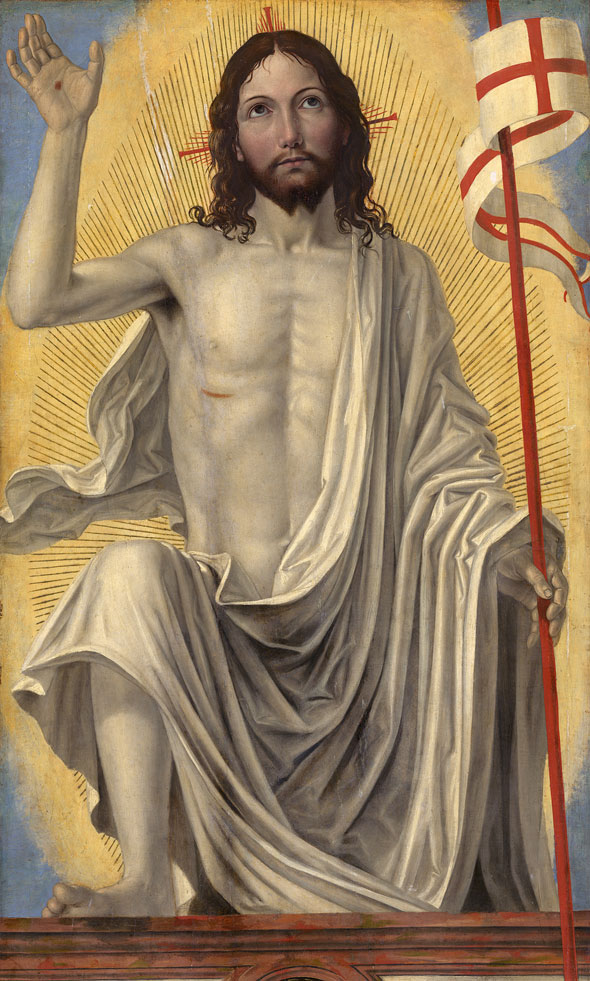
Resurrection, 1460s Piero della Francesca

Dwell in the Light

To you all this exhortation is from the word of the Lord: Dwell in the life, that with it ye may see the Father of life. And dwell in the light, with which light the world is condemned; which light comprehends the world’s wisdom; which light comprehends the world and their knowledge, and all the deceivers, which are entered into the world, (who are turned from the light,) with which light they are condemned, that is, the world, who hate the light, because their deeds are evil, and they will not bring their deeds to the light, because the light will reprove them, they hating it, and you that live in it. –The Works of George Fox [1831] vol. 7, p. 49-50)

On the evening of February 22, ten gathered for New Foundation Fellowship’s monthly study of Fox’s epistles. The beginning sentences of Epistle 41 (quoted above) introduce most of the themes presented in this writing: an exhortation to dwell in the Life and Light; the Light’s comprehension and condemnation of the world’s knowledge and deceivers, who are turned from the Light; and deceivers’ hatred of the Light and those who live in it.

We began by discussing the convincing, self-authenticating power of the Light that is recognizable by the elect, who are not deceived by man-made replication of it. The world’s hatred of the Light is one of the epistle’s themes and is examined beginning at 27:00 in the recording. That the Light actively leads out of sin is asserted starting at 37:50, and is followed by a detailed description of this life-giving activity, beginning at 39:30. A distinction is made between the nature of sin and its particular manifestations around 44:45, which includes a reference to Rom. 6:3-4 and Penington’s words on obedience:

There is no birth can believe aright but one; nor is there any birth can obey aright, but that birth which believes aright. The true believing is from the quickening virtue of God’s Spirit (all other faith is but dead faith); and the true obedience is in the newness of the Spirit Rom. 6:4 and 7:6 (Works, III:295)

The recording has been edited to reduce silence between speakers and runs a little short of an hour 

NFF discussion 2/21/21

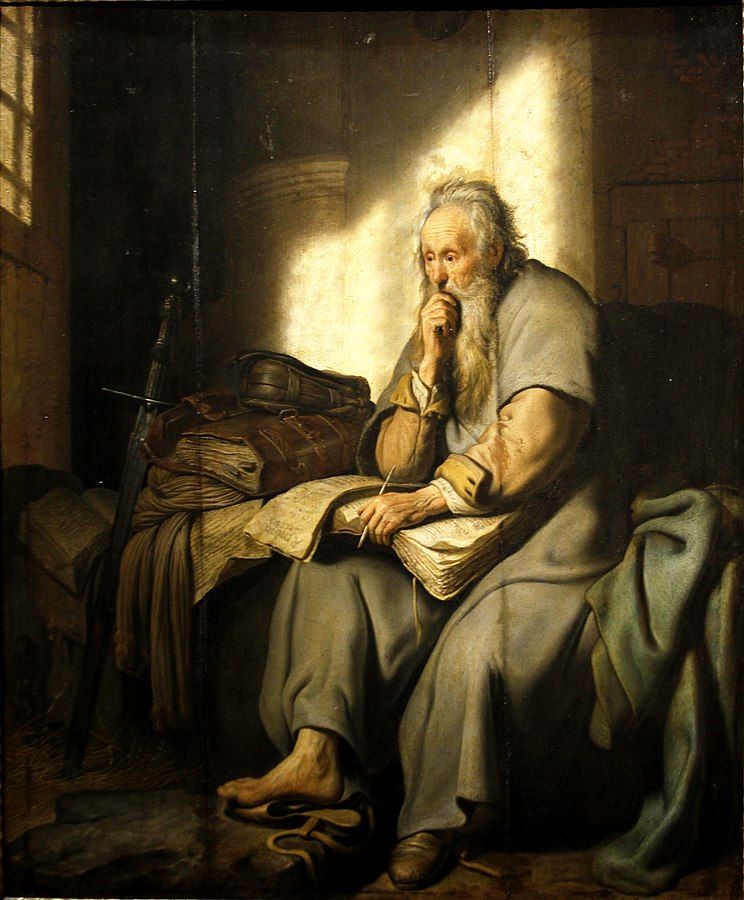
Paul in Prison, 1627 Rembrandt  

The Mystery of Faith in a Pure Conscience

Our rejoicing is in the testimony of our consciences, that in simplicity and godly sincerity (not with fleshly wisdom, but by the grace of God,) we have had our conversation in the world, not handling the word of God deceitfully, but in the manifestation of the truth, commending ourselves to every man’s conscience in the sight of God; and if our gospel be hid, it is hid to them that are lost. — The Works of George Fox, vol. 1, p. 377

The New Foundation Fellowship monthly study of Fox’s Journal met on the morning of February 13, eight people present. The text considered was Fox’s 1658 letter to Oliver Cromwell and chief magistrates, written “to make them sensible of their injustice and self-condemnation in blaming Papists for persecuting the Protestants abroad, while they calling themselves Protestants, were at the same time persecuting their Protestant neighbours and Friends at home” (377). Throughout this letter, Fox puts the guilt before the nation’s governors that they held in common with Papists whose persecution in central Europe these same governors had decried. 

Fox directs his readers to attend to the light in their consciences as the “touchstone” for righteousness, and to not turn to “profession and tradition” (377), “the commandments of men,” or “profess[ing] scriptures” (378) as guide to conversation and behavior: as these guides are outward standards, which can usurp the true inward guide: the light of Christ in the conscience. “These that teach for doctrine the commandments of men, are they that ever persecuted the life and power, when it came”(378). To the list of inadequate, outward standards, we added “social norms.” Discussion of the difference between heeding the conscience or, contrarily, heeding social norms begins at 48:45 in the recording. Neither heeding social norms nor other outward standards allow people to “exercise themselves to have always a ‘conscience void of offence towards God and man’”(379); that blessed condition occurs “only [through] being obedient to the commands of the Lord, to declare as they are moved by the holy ghost”(379).

Also of interest is some clarification on how prophetic ministry differs from persecution. This distinction was made beginning at 23:37; and then followed by a reading of Fox’s commission to minister the gospel (90), including more clarification on prophetic ministers’ work to overcome error and falsehood. We then heard some thought on the temptation to not risk offending others by confronting their error and falsehood, in order to avoid the typical resentment that follows, and the minister’s need to overcome this temptation and be willing “to suffer for conscience sake”(378).

If ye say, ‘how shall we know that these people, who say they witness these things do so or no?’ I answer, turn your minds to the light which Christ Jesus hath enlightened you withal, which is one in all (379).

The recording has been edited to reduce silence between speakers.

NFF discussion 2/13/21
Jerome Removing Thorn from Lion, 1445 Colantonio

Have Unity with That Which Is Pure

Eight people gathered on January 17th to read and discuss Epistle 40 from The Works of George Fox (1831), which is found in volume 7 on page 49. In this epistle, Fox conveys to Friends “the counsel of the Lord” to attend to His power, which is pure. As a person is enabled to have unity with that which is pure, he comes into unity with others who likewise know purity, “with hearts joined together!” In the spirit and power of the Lord, one may also discern what is contrary to that spirit, such as “men’s evil wills.”

Right use of language was a theme that ran throughout our discussion. When conscious of the inward Christ, one may be given to preach the gospel, which draws people into the unity that Fox calls for. Fox warns that “lightness and frowardness” run contrary to the purity that is sensed in Christ’s presence, and distract from receiving divine consolation. “Let thy words be few” (Eccles. 5:2) was brought forward as an early Quaker principle, cautioning against the human tendency to form words without the understanding or power that is received from God. An exchange on the necessary and intrinsic relationship between spirit and words can be found at 46:00 in the recording and runs through 54:20.

Also of interest is a conversation on the nature of righteousness in which self-righteousness is distinguished from the righteousness that comes from God. The ground and nature of each is explored beginning at 29:24 and ending at 39:11.

The recording has been edited to minimize silent time between speakers.

New Foundation Fellowship discussion 1/17/21
Woman in Revelation, 1498 Durer

From Whom Life Comes

Five Friends gathered on the morning of First month, the 9th, to read and discuss pages 372-377 in volume 1 of The Works of George Fox (1831). These journal entries from 1658 record two situations to which Fox responded: (1) a Jesuit’s holding forth an erroneous ecclesiology, and (2) an acquaintance’s troubled inward condition.

In the first piece of writing, Fox challenges the Jesuit to defend the church of Rome from the Quaker charge that it was “degenerated from the true church which was in the primitive times, from the life and doctrine, and from the power and spirit [the apostles] were in” (372). Our discussion begins at 19:30 in the recording by contrasting some Catholic ideas and practices with those of Quakers. The discussion moves to a comparison of the Quaker’s and Jesuit’s use of logic, and how the presence of Truth affects their argument’s outcome (26:55). From there, we share thoughts on the right relationship between reason and the spirit of Christ (36:00).

In the second part of our discussion, we look at Fox’s advice to lady Claypool who had made known to others her troubled state of mind. In this letter to Claypool, Fox advises her to still her mind and “be stayed in the principle of God,” which had been transgressed within. Among ourselves, we agreed that Fox’s direction for overcoming sin and transgression was a principle we had individually found to be valid, whether the troubling transgression was observed to be within ourselves, or whether it was seen to be manifested in others. References to the insurrection that had occurred at our nation’s Capitol a few days earlier filtered into our discussion. Having broadened our conversation to include transgression witnessed in others, we were led to consider the nature and meaning of the doctrine Christ takes away the sin of the world, as stated in John 1:29:

The next day John seeth Jesus coming unto him, and saith, Behold the Lamb of God, which taketh away the sin of the world.

The recording has been lightly edited to remove pauses between speakers.

New Foundation Fellowship discussion 1/9/21
Melencolia 1, 1514 Durer


Live in the Life

Our New Foundation Fellowship study group met on December 20th to discuss George Fox’s epistle 39, which can be found in The Works of George Fox (1831) on pages 48-49 of volume 7. Fox wrote this short epistle in 1653 to Friends in the north of England, and in it he offers encouragement to keep in the spirit of the living God. The epistle draws attention to the many benefits that accrue from continuing in this spirit: Friends will have dominion over earthly spirits, will know one another, enjoy the Lord’s presence, rightfully judge all that is contrary, receive wisdom, be preserved pure, be ordered to the glory of the Lord, and come to see the lamb of salvation.

Four participated in the discussion that begins with the observation that there are many references in this epistle to the living God; the words “living” and “life” appear frequently. The discussion moves into an exploration of the meaning of the words “believe” and “God” (4:50), and from there to “trust” and “obey” (noting the Greek etymology of the word “believe”). Then set forth is a theory that to be human (10:25) is to be righteously obedient to God. There follows an illustration and discussion of the inward sense of “an abundance of life” (13:25), and the dynamic of moving toward God is affirmed as entering joyful fulfillment. That this life is “the main thing” in Quaker faith, and yet unknown in most Quaker communities, is asserted (28:50), and this observation draws forth some thoughts on obstacles found in meeting communities that inhibit the finding of faith, which the human heart longs for in every age (31:27). A recounting of the end of Stephen Crisp’s tale “A Short History of a Long Travel from Babylon to Bethel” (44:35) underscores the paradox that coming into the faith entails both loss and gain. The discussion nears its end with some thoughts on faith and a reference to Hebrews 11:1.

NFF study 12/20/20
Christ Risen from the Tomb, c.1490 Bergognone

Things New and Old

Every one feeling the danger to his own particular in travelling abroad, there the pure fear of the Lord will be placed and kept in. Though they that travel may have openings when they are abroad, to minister to others; yet, for their own particular growth, they must dwell in the life which doth open; and that will keep down that which would boast.

The Works of George Fox (1831), 1:368

New Foundation Fellowship’s monthly study of Fox’s journal took place on the morning of the 12th, with five participating. We began on page 366 of volume 1 and read to the bottom of page 371. This passage is from an epistle written to Friends in which Fox addresses spiritual problems ministers might encounter as they travelled in their work among the worldly. Fox lists a number of particular errors that could arise and cautions the minister to be aware of them; to know and feel his own spirit; and thus to counteract the world’s effect upon him, that he may dwell in the life that undergirds his service.

Following the reading of the passage, our discussion begins at 22:21 in the recording, and centers on what constitutes the rightly ordered inward state of the minister as he encounters and speaks to the worldly. A contrast of two distinct inward sources and types of ministry – natural and godly – begins at 23:05; how the minister’s condition is undergirded by life in Christ is discussed beginning at 34:07; how gospel ministry differs from other kinds of preaching is at 43:35; and a personal reflection on ministering to the world, and the feelings that can arise begins at 46:30.

The recording has been edited to reduce the silent time between speakers. Matthew 13:52 is the Bible verse I was attempting to recall:    

Then said he unto them, Therefore every scribe which is instructed unto the kingdom of heaven is like unto a man that is an householder which bringeth forth out of his treasure things new and old (Mt. 13:52).

Approaches to Ministry

The evening of November 15th, seven Friends met via Zoom to participate in a New Foundation Fellowship study group. We read and discussed the final section of George Fox’s Epistle 38, which can be found on pages 46—48 of volume 7 of The Works of George Fox (1831).

In these few pages, Fox challenges the unrighteous teachers of his time and their enablers by censuring them with language drawn from prophecy recorded in Scripture. Our discussion of Fox’s method and intent begins at 9:30 in the recording, and thereafter we move into the more general topic of present-day ministry: the circumstances in which we work and some particular attitudes and approaches that have been found to be beneficial.

Though the “letter” of Fox’s approach cannot – nor should not – be replicated today, the impetus for his ministry, the guiding Spirit of Christ Within, remains unchanged throughout every age.

The recording has been edited to minimize the time between speakers, and is close to 47 minutes long. 

NFF Fox epistle study